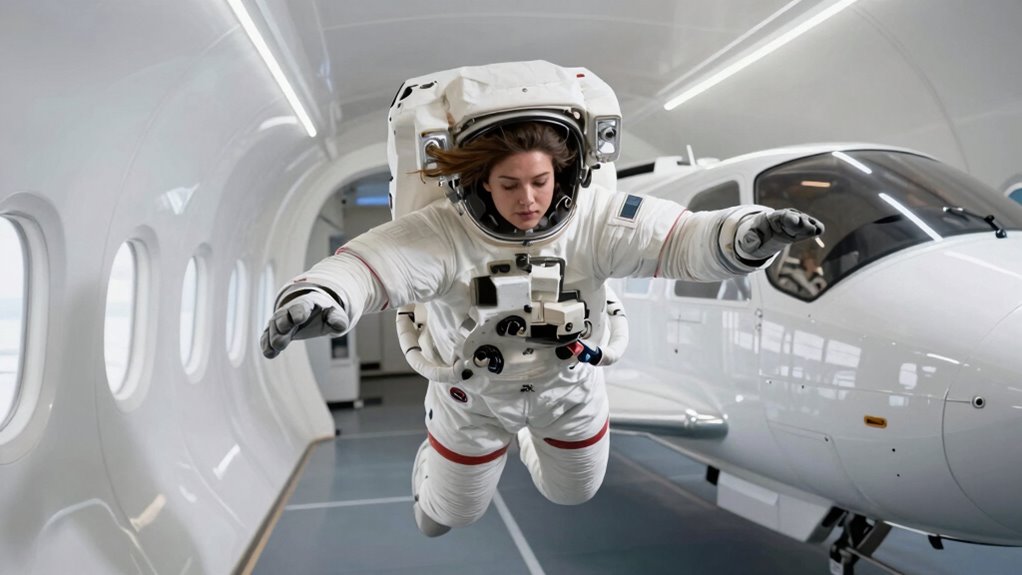

Many believe that in zero-G you’re completely weightless, but that’s a myth. What you really feel is continuous free-fall, creating microgravity conditions that make you float and seem weightless. Gravity still pulls on you and your spacecraft, but because you’re falling at the same rate, you don’t feel it. Understanding the difference can help you grasp why astronauts float and what they actually experience—there’s more than just weightlessness happening out there.
Key Takeaways
- Zero-G is microgravity, not complete weightlessness; astronauts still experience slight gravitational effects.
- Floating occurs because of continuous free fall, not the absence of gravity, creating a sensation of drifting.
- Astronauts feel a lack of up and down cues, leading to disorientation and new movement strategies.
- The feeling of weightlessness is due to being in free fall, not the absence of gravity.
- Movements in space differ from Earth, requiring adjustments and constant control despite the microgravity environment.
Does Zero-G Mean You’re Completely Weightless?
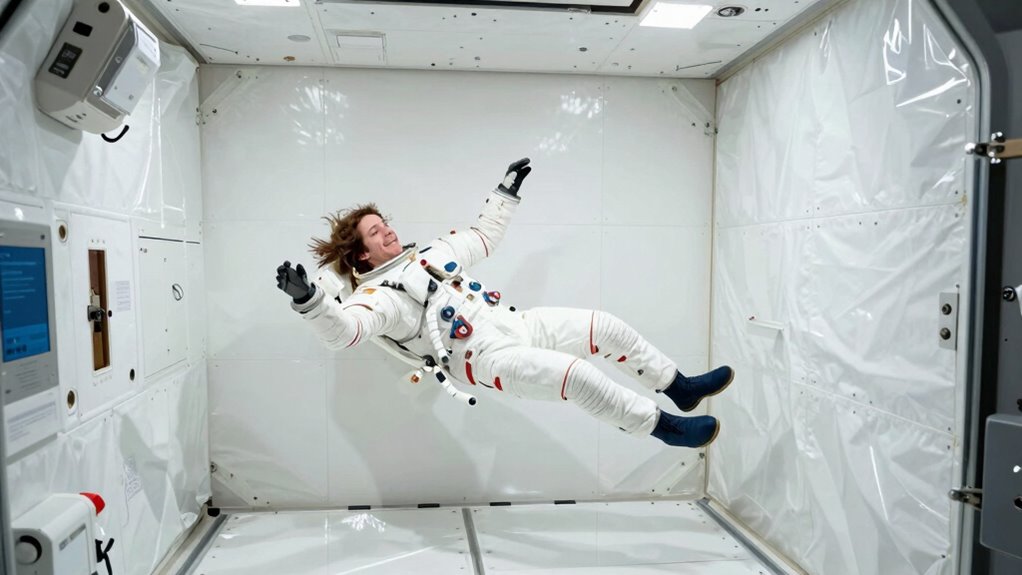
Many people assume that experiencing zero gravity means you’re completely weightless, but that’s not entirely true. When you participate in space tourism, you actually experience what’s called microgravity, a condition caused by free-fall rather than true zero gravity. Gravitational physics explains that gravity still acts on you, but because you and your spacecraft are falling at the same rate, you feel as if there’s no weight. This illusion occurs during orbital flight, where objects appear to float. So, while you might feel weightless, gravity is still at play—it’s just that your sensation of weightlessness results from continuous free-fall, not the absence of gravity itself. Understanding gravity helps clarify why this sensation occurs despite the presence of gravitational forces. Additionally, the effects of microgravity on the human body include fluid shifts and muscle atrophy, which are important considerations for astronauts.
How Does Gravity Really Work in Zero-G Environments?
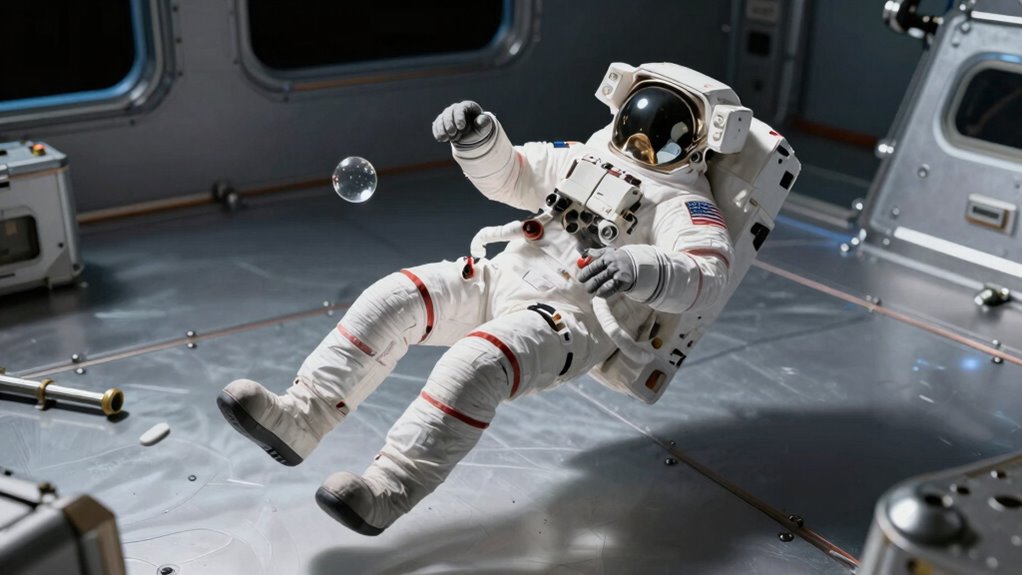
Gravity in zero-G environments still acts on everything, but its effects aren’t always immediately obvious. When you’re in space, gravity pulls on your body, the spacecraft, and even your space suit. However, since you’re in free fall around Earth, you don’t feel this pull as weight. Your space suit helps regulate your oxygen supply, but it doesn’t eliminate gravity; it keeps you alive and comfortable. Gravity’s influence keeps objects, including your equipment, in orbit with you. It’s not that gravity stops working; instead, you’re constantly falling toward Earth while moving forward fast enough to stay in orbit. This continuous fall creates the sensation of weightlessness, even though gravity is still acting on you. Orbital mechanics explains how gravity keeps objects in motion around planets without a sense of weight.
Why Do We Feel Like We’re Floating in Space?
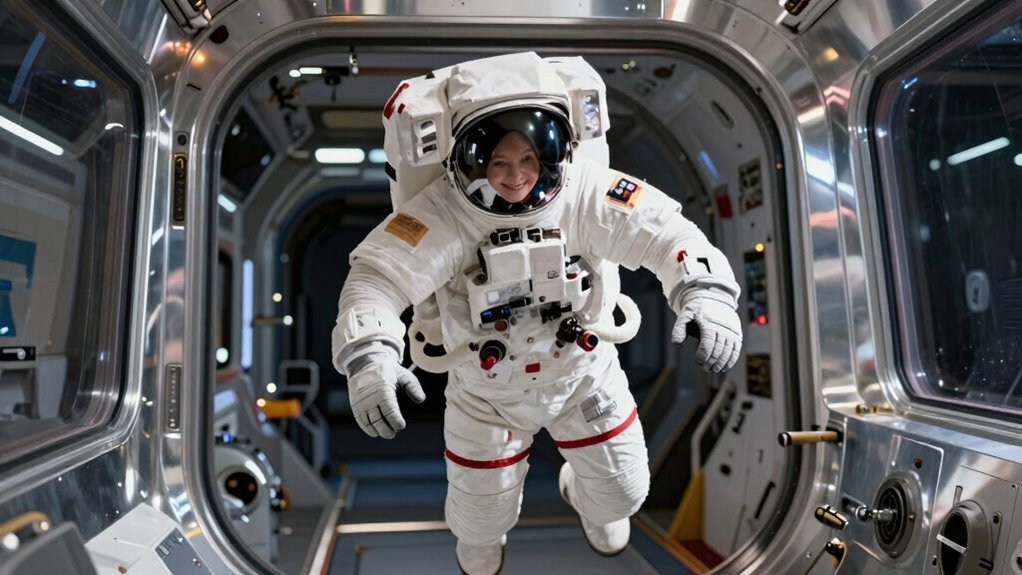
When you’re in space, the sensation of floating comes from your body and surrounding objects being in continuous free fall, which creates a state of weightlessness. This feeling isn’t about lacking gravity but results from the gravitational effects balancing with your motion. As space tourism grows, more people experience this unique sensation firsthand, often confused with “zero gravity.” In reality, gravity still pulls on you, but since you’re falling at the same rate as your spacecraft, you don’t feel it. This constant free fall cancels out the sense of weight, making you feel like you’re floating. Understanding gravity’s role helps clarify why this sensation occurs rather than the absence of gravity itself. It’s a fascinating outcome of gravitational effects in orbit, not a complete absence of gravity, which explains why astronauts and tourists alike experience this unique sensation. The mass and gravity of your body also influence how you perceive this feeling, even though the gravitational force remains present. Additionally, gravitational effects in orbit demonstrate how the balance of forces creates this illusion of weightlessness rather than the absence of gravity itself.
What Do Astronauts Actually Experience When They Float?
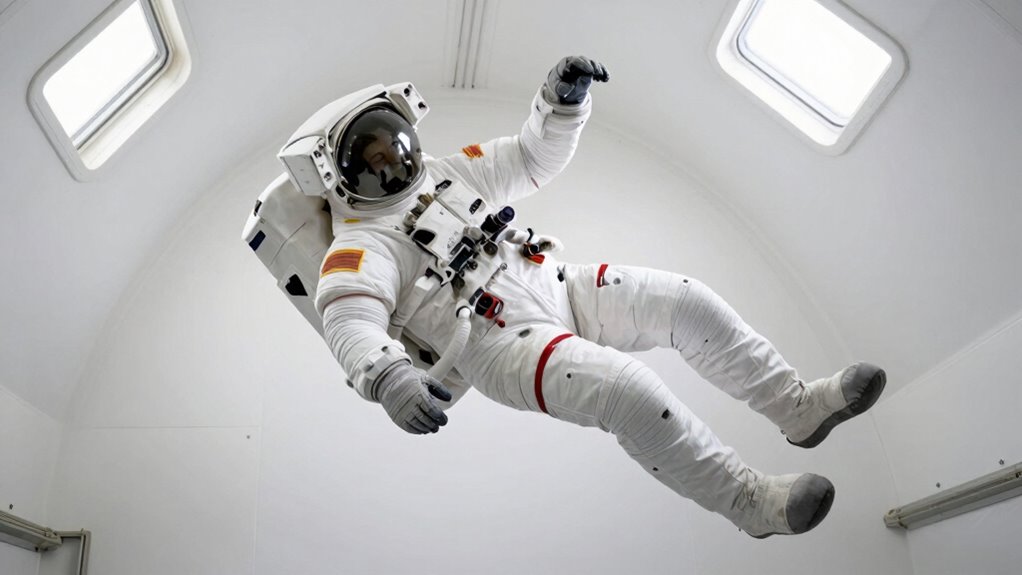
When you float in space, it feels like you’re constantly falling, but you’re actually in freefall around Earth. Your body responds to this sensation, and moving becomes different from what you’re used to on the ground. The spacecraft’s environment, including air currents and vibrations, also influences what you experience during weightlessness. Additionally, the design of the spacecraft often incorporates environmental controls to help manage these sensations and ensure astronaut safety. These systems are carefully engineered to mitigate the effects of microgravity on the human body and comfort. Moreover, astronauts often undergo training and adaptation to better understand and cope with these unique conditions. Understanding microgravity effects is crucial for planning long-duration missions and maintaining astronaut health.
Sensation of Freefall
Many people imagine floating in space as a gentle, weightless drift, but astronauts actually experience a sensation quite different from free-fall. Instead, they often encounter gravitational illusions that distort their perception of movement. In a space simulation, where gravity is effectively nullified, your body doesn’t register the usual cues of falling or pulling down. This can create a feeling of floating or drifting, but it’s not the same as falling freely. Instead, your brain struggles to interpret these unusual signals, leading to a disorienting sense of weightlessness that feels more like being suspended than falling. This mismatch between expectation and sensation can cause confusion, especially during initial exposure, making the experience of “freefall” in space more complex than simply falling through the air. Moreover, understanding how the brain interprets sensory signals can help explain why astronauts often feel disoriented when first entering microgravity. Additionally, the absence of gravitational cues can cause the brain to misinterpret the body’s position, intensifying disorientation during adaptation to space conditions. Researchers have also found that the vestibular system plays a crucial role in how astronauts perceive their orientation and movement in microgravity. Recent studies suggest that targeted sensory training may help astronauts adapt more quickly to these unusual conditions.
Body Movement Dynamics
As you begin to float in space, your body’s movements differ markedly from those on Earth due to the lack of gravity pulling you downward. Instead, you push off surfaces or objects to move, causing gentle, floating motions. Your space suit design plays a role by providing resistance and support, making movements smoother and more controlled. During zero-g training, you learn to coordinate these motions, understanding how to navigate without the familiar pull of gravity. Small shifts in your body create momentum, so every movement requires intentional effort. You quickly realize that floating is less about falling and more about deliberate motion, using your limbs to steer and stabilize. This dynamic environment demands awareness, but it also offers a unique sense of freedom in your body’s movement. Additionally, body movement dynamics are influenced by the absence of gravity, leading to a different sense of proprioception compared to Earth. Understanding microgravity effects can help astronauts adapt more effectively to space environments. Moreover, learning to control these movements enhances overall spacecraft safety by reducing inadvertent collisions or injuries. Recognizing how fluid redistribution impacts your body helps in preparing for long-duration missions and maintaining health in space. The experience of floating also emphasizes the importance of body awareness, which is crucial for executing precise tasks in space.
Spacecraft Environment Effects
Floating in a spacecraft feels like an endless, weightless drift through a confined environment where every movement influences your entire experience. The spacecraft design plays a vital role, with carefully arranged handrails, footholds, and storage to help you stabilize and move efficiently. You quickly learn that even small gestures can send you drifting unexpectedly, so you adapt to the environment’s unique physics. During zero-g training, you practice maneuvering and controlling your body to avoid collisions and maintain orientation. The environment’s microgravity affects everything from how you eat to how you sleep, requiring adjustments for comfort and safety. Overall, the spacecraft environment creates a surreal but manageable setting, shaping your daily routines and understanding of weightlessness. Additionally, astronauts develop spatial awareness to navigate efficiently and safely in this three-dimensional space.
How Your Body Reacts to Zero-G (Dizziness, Muscle Changes, and More)
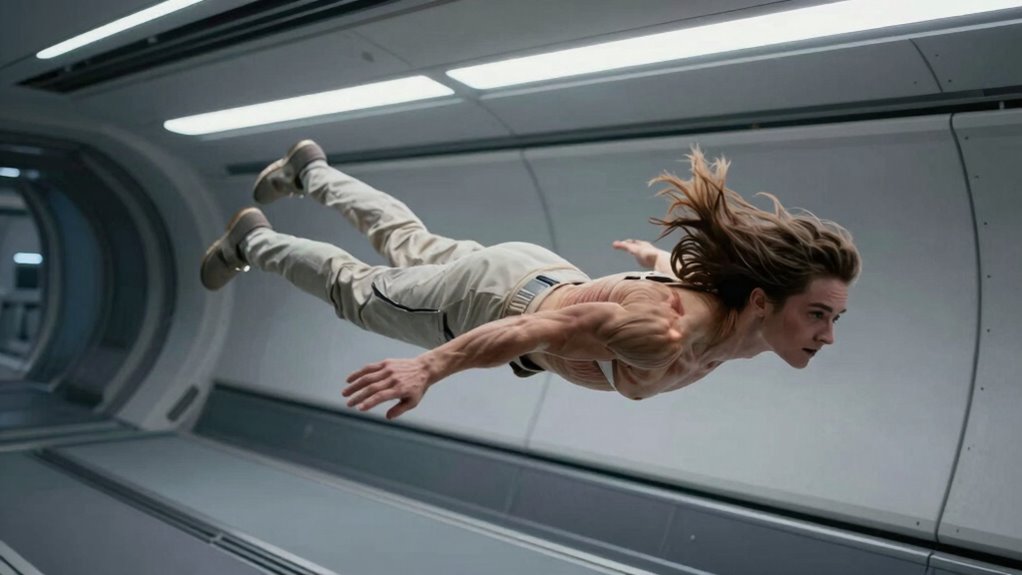
When you’re in zero-G, your balance feels off, and you might get dizzy or disoriented. Your muscles weaken, and your bones start losing density without gravity to keep them strong. These changes happen quickly and can affect your health long after you return to Earth.
Dizziness and Disorientation
Your body quickly reacts to the absence of gravity, often causing dizziness and disorientation. When you first experience zero-G, your inner ear, responsible for balance, struggles to interpret motion without gravity’s cues. During zero-g training, astronauts wear a space suit designed to simulate weightlessness and help your body adapt. This disorientation can feel strange, like spinning or losing your sense of up and down. Your brain receives conflicting signals between what your eyes see and what your inner ear perceives, intensifying dizziness. Over time, your body adjusts as your vestibular system recalibrates. However, initial moments in zero-G can be unsettling, emphasizing the importance of proper training, including familiarization with equipment and techniques to manage disorientation effectively.
Muscle Atrophy and Bone Loss
In zero gravity, muscles and bones quickly begin to weaken because they no longer bear the weight they normally support. Without gravity’s pull, your muscles experience muscle atrophy, shrinking and losing strength. Similarly, your bones suffer bone loss, becoming less dense over time. This process happens because your body adapts to the reduced load, making maintenance unnecessary. To understand this better:
| Effect | Cause | Duration |
|---|---|---|
| Muscle atrophy | Lack of weight-bearing | Within days to weeks |
| Bone loss | Reduced mechanical stress | Over months |
| Recovery | Exercise, rehab | Several weeks to months |
| Prevention | Resistance training | Ongoing in space |
Additionally, muscle atrophy and bone loss can be mitigated through targeted exercise regimens designed for microgravity environments. If unaddressed, these changes can impair your strength and bone health upon return to Earth. Additionally, implementing preventive measures can help mitigate these effects during extended space missions.
How Does Your Body Adjust to Zero-G Over Time?
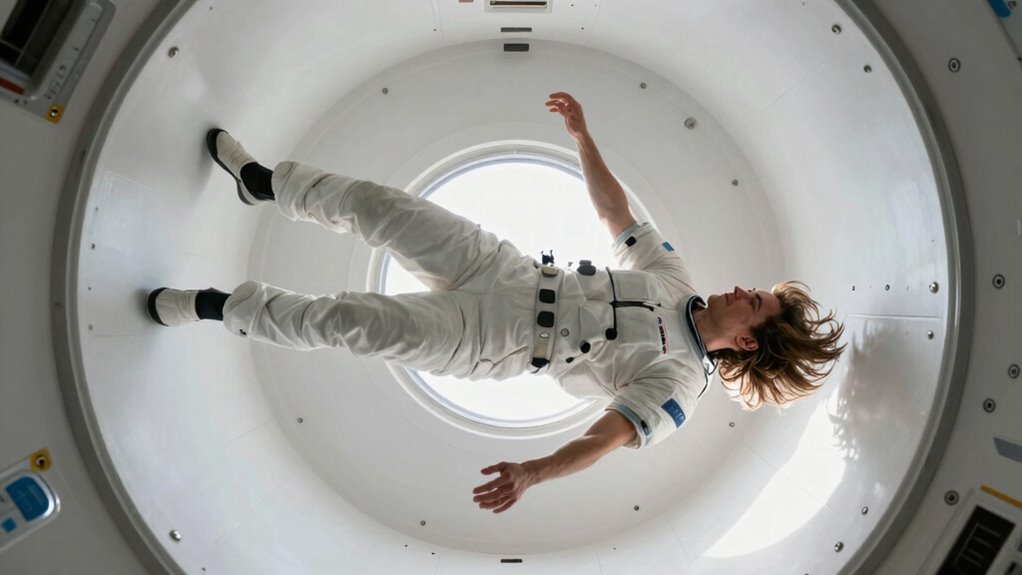
As your body spends more time in zero gravity, it begins to adapt to the absence of gravitational pull. Your gravity perception shifts, and your vestibular system, responsible for balance, recalibrates. Over time, you might notice:
In zero gravity, your vestibular system recalibrates, helping you adapt to new spatial orientations over time.
- Your sense of up and down becomes less reliable.
- The vestibular system adjusts, reducing dizziness.
- Your brain updates how it interprets signals from inner ear sensors.
- You develop new ways to maintain orientation without gravity cues.
- These adaptations are similar to deep-sky imaging techniques, where adjustments are made to optimize perception and accuracy in a different environment. This process involves sensory recalibration, which is essential for maintaining spatial awareness in altered conditions.
These changes help your body cope with the environment, but they also mean your perception of spatial orientation is constantly evolving. Your vestibular system learns to function without gravity’s pull, allowing you to move and balance in zero-G more effectively over time.
Microgravity vs. Zero-G: What’s the Difference?
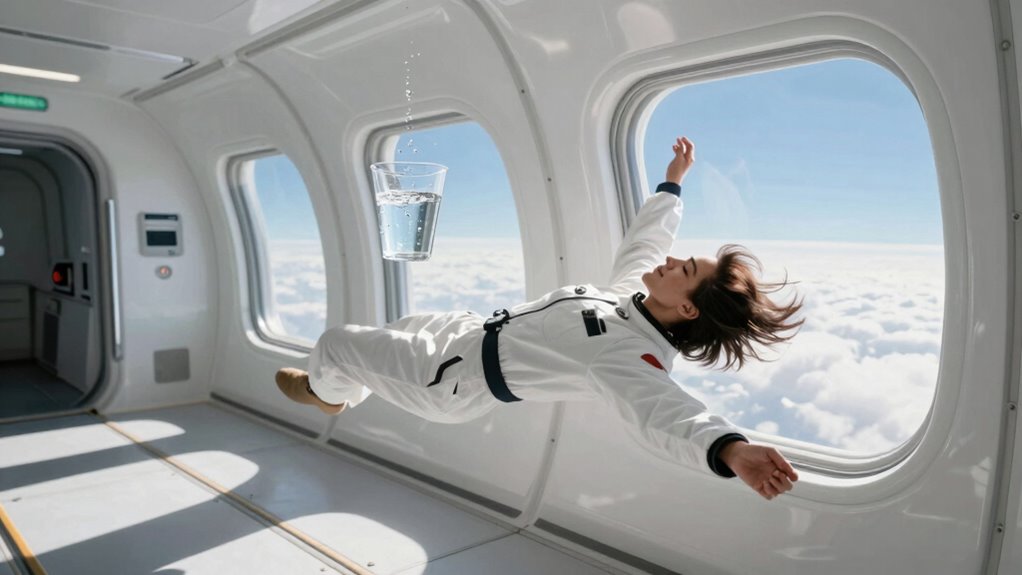
Understanding the difference between microgravity and zero-G helps clarify the environment astronauts experience. Microgravity refers to conditions where gravity’s effect is extremely weak, making you feel almost weightless, but some gravity perception remains. Zero-G, on the other hand, describes a state of continuous free fall, where you experience no weight sensation at all.
| Condition | Gravity Perception | Weight Sensation |
|---|---|---|
| Microgravity | Slight, still perceivable | Nearly absent, minimal |
| Zero-G | None | Completely absent |
| Earth Gravity | Strong, easily perceived | Full weight sensation |
This distinction helps you understand why you feel so different in space, even though gravity is still technically acting on you.
What Zero-G Really Feels Like: Busting the Myth
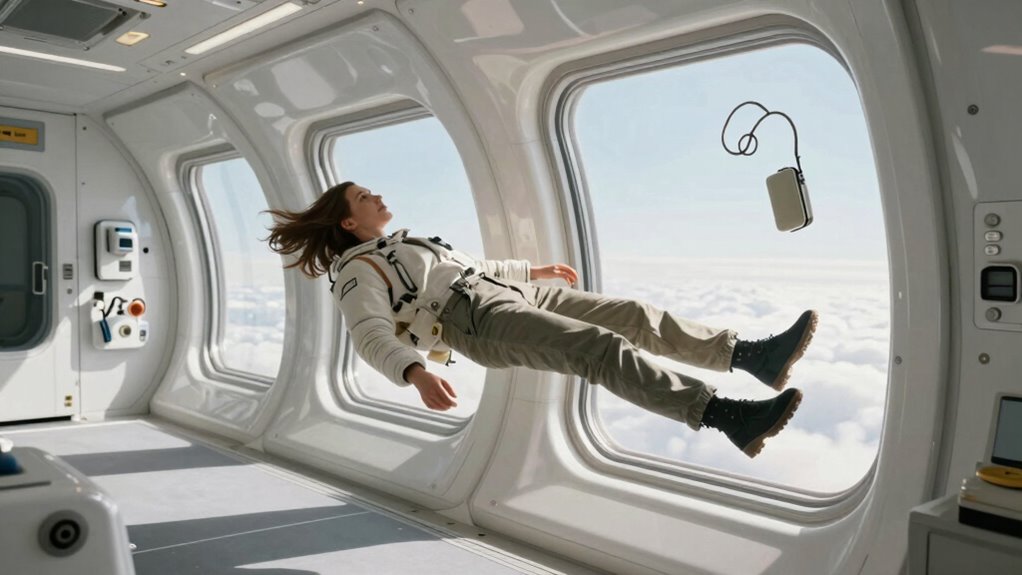
Many people imagine zero-G as a completely weightless experience, but the reality is a bit different. Instead of floating effortlessly, you’ll notice subtle sensations that challenge your expectations. During spacewalk challenges, astronauts often report a feeling of slight disorientation rather than pure weightlessness. Here’s what you’ll actually experience:
- A sensation of drifting, like being gently pushed or pulled.
- The need to stabilize yourself because movement isn’t as easy as it looks.
- A feeling of floating that requires constant adjustment.
- The importance of astronaut training to master these subtle shifts and handle spacewalk challenges effectively.
Zero-G isn’t about feeling completely weightless; it’s about adapting to a different kind of movement and sensation.
Frequently Asked Questions
Can Zero-G Environments Be Simulated on Earth?
Yes, you can simulate zero-G environments on Earth through gravity simulation techniques. By performing specialized aircraft maneuvers, such as parabolic flight paths, you experience brief periods of weightlessness. These maneuvers create a near-zero gravity environment, allowing you to feel as if you’re floating. This method is widely used for astronaut training and scientific experiments, giving you a realistic zero-G experience without leaving the planet.
How Does Zero-G Affect Human Cardiovascular Health?
Zero-g messes with your cardiovascular health by disrupting blood flow and raising your heart rate. You might feel like your ticker’s on a roller coaster, constantly racing without warning. Over time, this can weaken your heart and cause blood to pool in your head, leading to dizziness or even fainting. So, while floating sounds fun, your heart’s trying to tell you, “Hey, don’t forget I’m still here!”
Are There Long-Term Effects of Extended Weightlessness?
Yes, extended weightlessness can cause long-term effects like muscle atrophy and reduced bone density. You might experience weakened muscles and fragile bones because your body doesn’t need to support weight like on Earth. To counteract this, astronauts perform regular resistance exercises and take supplements. Staying active and monitoring your health helps minimize these risks, but prolonged zero-G exposure still poses significant challenges to your physical well-being.
How Do Astronauts Sleep and Eat in Zero-G?
In zero-G, you sleep attached to a wall or ceiling with straps to prevent floating, making bed comfort unique but effective. Astronauts eat a variety of pre-packaged, recyclable foods, often using utensils attached to trays. Studies show that maintaining food variety boosts morale. You quickly adapt to floating while sleeping or eating, finding it a surprisingly efficient way to stay nourished and rested, despite the unusual environment.
Is Zero-G Dangerous for Fragile Objects or Equipment?
Zero-g can pose risks to fragile items and equipment safety if you’re not careful. In microgravity, objects tend to float freely, increasing the chance of damage if they’re not secured properly. You need to use special restraints and storage solutions to prevent breakage or misplacement. By following safety protocols, you minimize risks, ensuring fragile items stay intact and equipment functions correctly during your mission.
Conclusion
Now that you know zero-G isn’t pure weightlessness but a strange dance with gravity, imagine it as a cosmic waltz where your body learns new steps. It’s not about floating like a feather, but about your muscles and senses adjusting to a different tune. So, next time you hear “weightless,” remember it’s more like gliding through a celestial ballet—an incredible, real-life performance where your body’s adaptation steals the show.