TL;DR
A Fit&Well contributor who says they have trained for 12 years has shared a 30-minute lower-body workout designed for home use. It combines two circuits, including single-leg exercises, and offers modifications; the report does not provide evidence that the routine is suitable for everyone or establish specific outcomes.
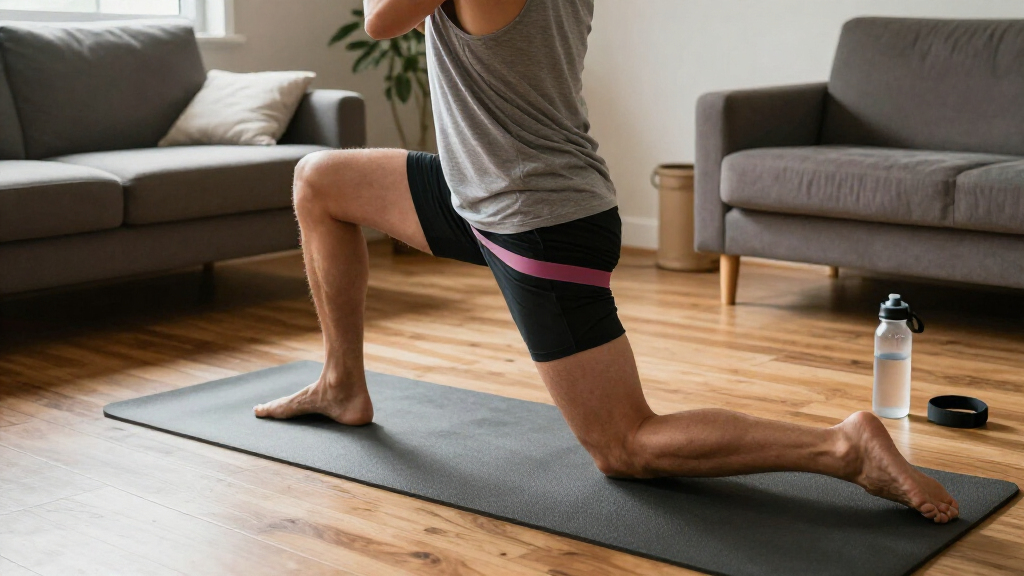
Fit&Well has published a 30-minute lower-body workout from a contributor who says they have trained for 12 years, including preparation for CrossFit and Olympic lifting competitions. The home routine uses two circuits, with several single-leg exercises, and is presented as a way to work on strength, stability and core control in a short session.

Get wellness gear delivered free with Prime
- Fast, free delivery on millions of items
- Prime Video, Amazon Music and more included
- Member-only deals all year
The contributor says their training changed after they were diagnosed with a bulging disc in the lower back. They report taking a year away from training and then spending two years in rehabilitation. They now train three times a week for about 30 minutes per session, describing this approach as shaped both by other commitments and by what their body can manage.
The workout begins with two rounds of four exercises: bear holds with shoulder taps, single-leg Romanian deadlifts, single-leg good mornings and wide squats. The first circuit includes six shoulder taps per side, six deadlifts per side and eight to 10 repetitions for the good mornings and squats. The article then prescribes three rounds of a second circuit, featuring toe-assisted single-leg squats and a single-leg Romanian deadlift that flows into a lateral lunge.
For the second circuit, the suggested range is eight to 10 repetitions for toe-assisted squats and five to six repetitions per side for the deadlift-to-lateral-lunge combination. The report also gives ways to adjust some movements: for example, a person can reduce the depth of a single-leg deadlift or keep the back toes on the floor for support. Light weights are suggested as a way to make certain exercises harder.
A Short Routine Built Around Balance
The routine offers readers a structured option for a short home strength session, rather than requiring a gym or a long workout. Its repeated single-leg movements place balance and control alongside lower-body strength work, while the bear hold and shoulder taps add a core-stability element. These are the aims described by the contributor, not results established by a study in the report.
The contributor’s account also puts the workout in the context of returning to exercise after an injury and adapting training volume. That may be useful to readers comparing routines, but it does not mean the sequence is a rehabilitation plan or that it is appropriate for people with back pain or other health concerns. The article does not report testing the workout across a group of participants or measuring changes in strength, stability or injury risk.
Products Worth Considering

Garmin Forerunner 165 GPS Running Smartwatch, 43 mm, Black

Hyperice Normatec Elite Wireless Compression Boots, Short

Therabody SmartGoggles 2nd Generation Heated Eye and Temple Massager
As an affiliate, we earn on qualifying purchases.
How the Contributor Changed Training
The contributor describes an earlier period of five training days a week focused on preparing for CrossFit and Olympic lifting competitions. They also say they earned Level 3 personal trainer and yoga therapist qualifications during that time. After the back diagnosis and rehabilitation period, they shifted to three weekly sessions of roughly half an hour.
The report says two of those sessions are divided between upper- and lower-body work, while another revisits skills the contributor enjoyed before the injury, such as pull-ups and handstands. The new lower-body plan is framed as a companion to an upper-body routine previously shared by the same writer. Fit&Well suggests the pair can be done weekly and that exercise difficulty can be increased gradually through the end of 2026; the supplied report does not specify a progression schedule.
“I now train three times a week, spending around 30 minutes or so on each session.”
— Fit&Well contributor
Who Should Modify the Exercises
The supplied report does not specify its publication date, identify the contributor by name in the material provided, or say whether the workout has been reviewed by a clinician. It also does not include independent testing, participant results or evidence that the routine prevents injury or addresses a bulging disc.
Although the article gives easier options for some exercises, it does not set out guidance for people with current back symptoms, balance limitations or other conditions. Readers should not assume that an exercise described as manageable by the contributor will be safe for everyone. The appropriate range of motion, load and exercise choice can vary by person.
Progression Depends on the Reader
The article suggests repeating the upper- and lower-body sessions each week and gradually increasing the difficulty of individual movements. It does not give dates for future updates or a fixed week-by-week plan, so any progression would depend on the reader’s ability and response to the exercises.
People who are new to strength training or have a history of back problems may wish to seek guidance from a qualified health professional before trying the routine. If a movement causes pain or symptoms, the report offers no reason to push through it; the exercise should be stopped and advice sought as appropriate.
Key Questions
What is in the 30-minute lower-body workout?
It has two circuits: four exercises performed for two rounds, followed by two exercises performed for three rounds. Moves include wide squats, single-leg Romanian deadlifts, toe-assisted single-leg squats and a deadlift-to-lateral-lunge combination.
Does the routine require weights?
No weights are required for the listed base movements. The article suggests holding a light weight to make some exercises harder, while also describing ways to reduce the challenge of certain moves.
Is the workout designed to treat a back injury?
No. The contributor discusses returning to training after a bulging-disc diagnosis, but the report presents a personal workout, not a medical or rehabilitation program. It does not establish that the exercises treat back problems.
How often does the article suggest doing the routine?
Fit&Well presents the lower-body session as part of a pair of upper- and lower-body workouts that can be done each week. It recommends gradually progressing difficulty but does not provide a detailed schedule.
Source: fitandwell.com