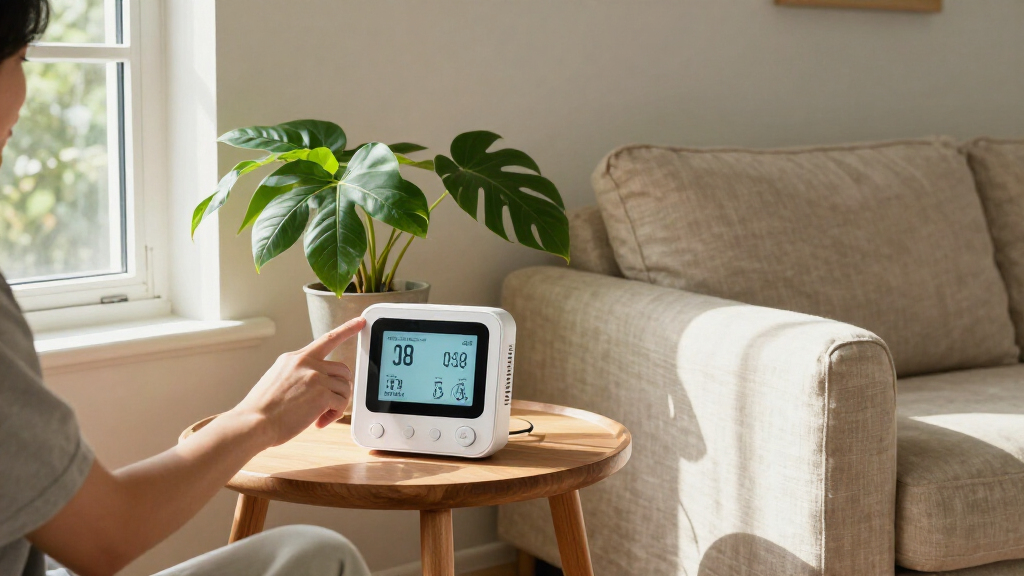
This checklist is for anyone building an at-home air quality setup with wellness tech for different rooms and needs. It covers purification, monitoring, humidification, dehumidification, and a replacement-filter slot, plus guidance for choosing a ventilation fan.

Get wellness gear delivered free with Prime
- Fast, free delivery on millions of items
- Prime Video, Amazon Music and more included
- Member-only deals all year
The sections follow those jobs in order, from cleaning and measuring indoor air to managing moisture and maintaining equipment. Each product name identifies a specific pick; the accompanying notes focus on matching its stated form and capacity to your space and setup.
Start by identifying the room, the air concern you want to address, and any installation limits. Check room coverage and compatibility against the product details before buying, then use the look-for list to confirm the essentials for your space.
Smart Air Purifier
A purifier is the centerpiece of a room-by-room air quality checklist because it is the item intended to treat the air in the space where you use it. The listed pick is the PuroAir 130i Smart Air Purifier – 750 ft², Black (2-Pack). Its stated coverage and two-pack format make it especially important to decide whether you are planning for one larger area or two separate rooms. Compare the listed coverage with the actual room dimensions, and check how the manufacturer describes coverage when rooms connect or doors remain open.
A common buying mistake is treating a coverage figure as a guarantee for every layout. Ceilings, partitions, and placement can affect how air moves, so consider the intended location and keep the unit clear of obstructions according to its instructions. Also confirm which controls and app or network requirements apply to the smart functions before assuming they will work with your home setup. For a two-pack, verify that both units suit the rooms you have in mind and that their placement and maintenance needs are manageable. Match the model and replacement filter details carefully so upkeep remains straightforward.
What to look for:
- Compare the stated 750 ft² coverage with each room’s dimensions.
- Decide whether the two-pack fits one zone or two separate rooms.
- Check manufacturer guidance for open layouts, placement, and clearance.
- Confirm smart-control and network requirements for your home.
- Verify compatible replacement filters and the recommended maintenance steps.
PuroAir 130i Smart Air Purifier – 750 ft², Black (2‑Pack)

The PuroAir 130i quickly cleans rooms up to 750 sq ft with a quiet, Wi‑Fi‑enabled system that can be controlled from a smartphone app. Its three‑layer CarbonTech filter removes up to 99.9% of dust, pollen, smoke, pet dander and VOCs, helping reduce allergy symptoms and improve sleep quality.
Pros:
- Covers large rooms (up to 750 sq ft) with fast air cleaning
- High filtration efficiency removes dust, pollen, smoke, pet dander and VOCs
- Wi‑Fi connectivity allows remote fan speed and setting control via app
- Quiet operation suitable for bedrooms
Cons:
- No built‑in real‑time air quality sensor for automatic adjustments
Best for: Households planning purifier placement in two rooms.
Not ideal for: Anyone who needs a single unit for a compact space.
Bottom line: Match the two-pack’s stated coverage and placement guidance to the rooms you intend to treat.
Indoor Air Quality Monitor
A monitor helps you understand what the air quality device is reporting in the room where it sits. The pick is the Airthings View Plus Radon & Air Quality Monitor, so this checklist slot is about measurement rather than air treatment. Before choosing a location, review the product instructions for placement and setup, then consider whether the proposed spot represents the space you care about. A reading from one room should be interpreted as information about that measurement location, not automatically as a summary of every room in the home.
A frequent mistake is buying a monitor without deciding which readings and display or connectivity features matter to you. Check the product’s listed sensor details, display, app requirements, and any power or network needs, and make sure the setup fits how you expect to review readings. Consider whether you want a device in a frequently occupied room or a location tied to a particular concern. If you plan to compare rooms, first confirm whether the product supports the way you intend to move or use it. Follow the maker’s guidance for startup and ongoing use, and keep its model information handy when reviewing readings or support materials.
What to look for:
- Review the product’s listed measurements and sensor details.
- Check display, app, power, and connectivity requirements.
- Choose a placement that represents the room you want to monitor.
- Confirm instructions for setup and interpreting readings.
- Check whether the intended room-to-room use matches product guidance.
Airthings View Plus Radon & Air Quality Monitor

The Airthings View Plus is a battery-powered, WiFi-connected indoor air quality monitor that tracks radon, PM2.5, CO2, VOCs, humidity, temperature, and air pressure. It features a customizable eInk display and connects to the Airthings app for real-time data, trend analysis, and health notifications.
Pros:
- Comprehensive monitoring of seven different air quality metrics including radon and PM2.5
- Battery-powered and cable-free design allows for flexible placement anywhere in the home
- Real-time data and historical trends accessible via the free Airthings app
- Long battery life and low maintenance with no need for frequent calibration
Cons:
- Requires a constant WiFi connection and a mandatory user account to function
- Data is stored in the cloud, which may not appeal to users preferring local-only storage
- Requires smartphone app integration for full functionality and setup
Best for: People who want a dedicated indoor air monitor.
Not ideal for: Anyone seeking a device whose primary role is air treatment.
Bottom line: Choose a representative location and confirm the monitor’s listed measurements fit your needs.
Smart Humidifier
Humidification belongs on an air quality checklist when you want to manage moisture in a particular room. The listed option is the AEOCKY BPA-Free Evaporative Humidifier for Rooms up to 1,500 sq. ft.. Use its stated room coverage as a starting point, then compare that figure with the room dimensions and layout. The product name identifies an evaporative model, so check the instructions for the intended water, cleaning, and placement practices before fitting it into your routine.
A common mistake is choosing by the largest stated room figure alone. A connected floor plan, room divisions, and where the unit can be placed all matter when you decide whether one device fits your intended space. Confirm the exact model’s controls, smart features, power needs, and maintenance guidance, rather than assuming that every feature implied by a category label is included. Think through where it will sit, how you will access it for cleaning, and whether the location follows manufacturer clearance guidance. If you are comparing this with a different humidifier type, focus on the model’s documented operation and upkeep so that the choice fits both your room and your willingness to maintain it.
What to look for:
- Compare the stated 1,500 sq. ft. coverage with the room layout.
- Confirm the exact model’s smart controls and connectivity requirements.
- Review water, cleaning, and maintenance instructions before choosing a location.
- Check manufacturer placement and clearance guidance.
- Make sure the unit’s operating style suits your intended routine.
AEOCKY BPA-Free Evaporative Humidifier for Rooms up to 1,500 sq. ft.

This evaporative humidifier uses a washable, reusable wick filter to add moisture without visible mist or dispersing mineral white dust, and it supports tap water use. It offers up to 800 mL/h output, Auto, Humidistat, and Sleep modes, adjustable humidity from 40–80% RH, and features including a timer, child lock, low-water reminders, and a 180-minute Dry Mode.
Pros:
- Evaporative design keeps minerals mainly in the wick filter, reducing white dust in the air.
- Tap water compatible, so distilled water is not required.
- Washable, reusable wick filter and Dry Mode support routine care.
- Multiple modes and adjustable humidity settings.
Cons:
- Wick filter requires regular cleaning and eventual replacement.
- Actual output and runtime vary with operating conditions and filter condition.
Best for: People seeking an evaporative humidifier for a larger room.
Not ideal for: Anyone unable to follow the unit’s ongoing cleaning guidance.
Bottom line: Use the stated coverage as a starting point and confirm the room and care requirements.
Smart Dehumidifier
A dehumidifier addresses moisture management, so placement and installation conditions deserve attention before choosing a model. The pick is the ALORAIR Smart Wi-Fi Crawl Space Dehumidifier, 70-Pint. Its name points to a crawl space application and a stated pint capacity, making it important to compare the intended area and installation conditions with the manufacturer’s specifications. Check that the model’s dimensions and setup requirements can be accommodated in the space.
A common buying mistake is selecting a crawl space unit for another room without confirming that the product instructions support that use. Review how drainage, power, access, and Wi-Fi connectivity are handled, and make sure you can reach the unit for setup and maintenance. The capacity label alone does not establish that a particular space or moisture situation is a match; use the maker’s sizing guidance for the conditions you expect. Before purchase, confirm the exact model, installation orientation, and any required accessories. Plan for access to the device after installation, since a placement that makes routine checks difficult can complicate ownership.
What to look for:
- Confirm the crawl space is an intended application in the product guidance.
- Compare the stated 70-pint capacity with manufacturer sizing recommendations.
- Check drainage, power, dimensions, and installation requirements.
- Verify Wi-Fi setup requirements and signal availability in the space.
- Plan accessible placement for setup and ongoing maintenance.
ALORAIR Smart Wi-Fi Crawl Space Dehumidifier, 70-Pint

This Wi-Fi-enabled dehumidifier removes up to 35 pints of moisture per day under AHAM conditions and is designed for spaces up to 1,000 square feet. It includes a condensate pump with a 19.6-foot hose, automatic defrost and restart, and app-based humidity controls.
Pros:
- Wi-Fi and companion app allow remote monitoring and humidity adjustments.
- Built-in pump and 19.6-foot hose support gravity drainage or upward pumping.
- Automatic defrost and restart support continuous operation.
Cons:
- Weighs 36.3 pounds, which may make moving it less convenient.
- Coverage is limited to spaces up to 1,000 square feet.
Best for: People selecting a Wi-Fi dehumidifier for a crawl space.
Not ideal for: Anyone looking for a general room model without installation checks.
Bottom line: Confirm the space, capacity guidance, drainage, and access before choosing this crawl space unit.
HEPA Filter Replacement
Replacement filtration is a maintenance slot: the right item depends on the equipment it is meant to support. The listed pick is the HEPA-AIRE H2000L Negative Air Machine. Its product name identifies a negative air machine, so verify whether this is the equipment you need rather than assuming it is a standalone replacement filter. Check the product documentation for included components and compatible replacement parts before ordering.
A common mistake is using the checklist heading as a substitute for checking the exact part. Match the model number and filter designation to the equipment manufacturer’s compatibility information, and confirm whether the listing is for the machine itself or a replacement element. If your goal is to replace a filter in a different purifier, use that purifier’s model and approved filter reference to find a compatible item. Also check dimensions, installation steps, and any replacement schedule provided by the manufacturer. Keep the name and model of your existing equipment available while comparing listings to reduce the chance of choosing an item that does not fit your setup.
What to look for:
- Confirm whether the listing is for a machine or a replacement filter.
- Match the product model and part designation to your equipment documentation.
- Check compatibility before ordering for a different purifier.
- Review filter dimensions and installation instructions.
- Follow the equipment maker’s replacement guidance.
HEPA-AIRE H2000L Negative Air Machine
The HEPA-AIRE H2000L is a negative air machine designed for asbestos abatement and air cleaning. It has a galvanized steel cabinet with leak-resistant, zero-bypass construction using solid rivets.
Pros:
- Designed for asbestos abatement
- Zero-bypass construction
- Durable, leak-resistant cabinet
Cons:
- Heavy at 140 pounds
- Large dimensions may make it difficult to move or store
Best for: People seeking the named HEPA-AIRE negative air machine.
Not ideal for: Anyone needing a replacement filter for an unrelated purifier.
Bottom line: Verify the listing type and equipment compatibility before treating this as a filter replacement.
Smart Ventilation Fan
A ventilation fan can be part of an air quality plan when you want to move air through a specific room or area. This checklist has no product pick for this slot, so begin with the room and the installation constraints. Consider whether the fan is intended for a bathroom, kitchen, or another location, and check the requirements for that exact application before comparing models.
A common mistake is choosing a fan based on a broad “smart” label without checking what the controls actually do. Review the installation dimensions, duct or vent compatibility, power requirements, control options, and any connection requirements. Match the fan to the existing opening and route, or establish what changes installation would require. Check the manufacturer’s instructions for the intended room and use, and confirm that the controls fit your household’s preferred setup. If you are replacing an existing fan, record its dimensions and connection details first. If it is a new installation, make sure the planned location and vent path are suitable before selecting a model.
What to look for:
- Match fan dimensions to the opening and planned installation.
- Confirm duct or vent compatibility for the location.
- Check power, control, and smart connectivity requirements.
- Review manufacturer guidance for the intended room and use.
- Record existing fan and connection details when replacing a unit.
Buy in order of need: start with the room where you want air treatment, then add a monitor if you want dedicated readings. Address humidification or dehumidification only for the spaces and use cases that fit their product guidance, and confirm replacement-part compatibility before ordering. For each purchase, check fit, setup, and upkeep against the exact model.
You can build the checklist one room at a time and refine it as your needs become clearer. Keep model details and care instructions together, and use the manufacturer’s guidance when placing, connecting, or maintaining each device. A thoughtful setup starts with the right match for your space.