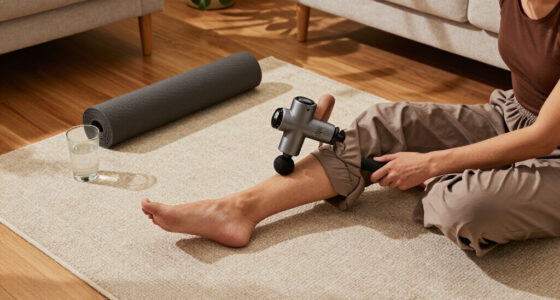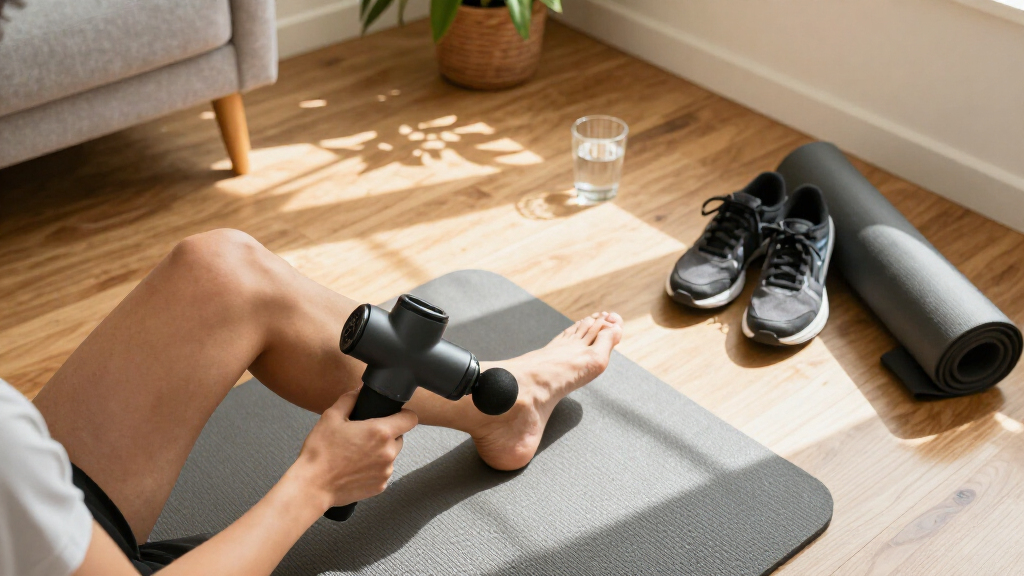
This guide shows beginners how to use a massage gun on appropriate muscles after exercise, choose an attachment, set a comfortable speed, and recognize when to stop. A session usually takes 5-10 minutes. A massage gun may ease temporary muscle tightness, but it does not prevent injury or replace rest, hydration, or medical care.

Get wellness gear delivered free with Prime
- Fast, free delivery on millions of items
- Prime Video, Amazon Music and more included
- Member-only deals all year

TOLOCO Massage Gun with 10 Heads and Silent Brushless Motor
- ✔ Motor: Brushless
- ✔ Maximum speed: 3200 rpm
- ✔ Penetration depth: 12mm

AERLANG Massage Gun with Heated Head and LCD Display
- ✔ Massage heads: 6
- ✔ Adjustable speeds: 20
- ✔ Heated head: 3 settings, up to 131°F

RENPHO Active Thermacool 2 Massage Gun with Heat and Cold Control
- ✔ Motor: Brushless
- ✔ Percussion speed: Up to 3200 RPM
- ✔ Amplitude: 10mm
Difficulty: Beginner | Time: 5-10 minutes per session
What You’ll Need
Tools & Materials:
- Massage gun with a charged battery
- User manual for the device
Knowledge:
- Basic awareness of which muscles you exercised
- Ability to distinguish mild pressure from pain or numbness
Read the device manual for attachment and speed guidance. Do not use a massage gun over an injury, unexplained pain, swelling, bruising, or an area with reduced sensation. If you have a bleeding disorder, take blood-thinning medication, are pregnant, have a medical condition affecting circulation or sensation, or have concerns about using percussion therapy, ask a qualified health professional first.
TOLOCO Massage Gun with 10 Heads and Silent Brushless Motor
For buyers who want one adaptable percussion tool, TOLOCO offers the widest attachment selection here: 10 heads for changing how you approach different muscle groups. Its 3200 rpm maximum speed and 12mm penetration-depth claim give it a substantial-sounding percussion profile, while the LED touch screen puts speed adjustment and battery monitoring in view. Together, those details make it a flexible starting point for recovery routines that center on percussion rather than temperature therapy.Compared with AERLANG, TOLOCO gives us more listed heads, but AERLANG offers 20 speeds and a heated head. Compared with RENPHO, TOLOCO lists a 12mm penetration depth rather than 10mm amplitude, though those measurements are not directly interchangeable. TOLOCO also claims up to six hours of battery life, but actual duration varies by speed, and the USB charging plug is not included. Choose it for variety and everyday practicality; skip it if heat or cold is essential to your recovery routine.
Pros:
- 10 interchangeable heads provide the largest attachment selection in this comparison.
- LED touch screen displays battery information and allows speed adjustment.
- Brushless motor is described as quiet, with a stated noise range of 40–50 dB.
- Stated battery life reaches up to six hours, depending on speed.
Cons:
- USB charging plug is not included.
- Battery duration can vary significantly with the selected speed.
- No heat or cold therapy is listed.
Best for: Buyers who want a broad range of attachments and a general-purpose percussion tool for different muscle groups.
Not ideal for: People who specifically want built-in heat or cold, or who need a charging plug included in the package.
Bottom line: We rank TOLOCO first for its combination of attachment variety, accessible controls, and stated battery endurance, provided percussion alone suits your routine.
“We rank TOLOCO first for its combination of attachment variety, accessible controls, and stated battery endurance, provided percussion alone suits your routine.”
AERLANG Massage Gun with Heated Head and LCD Display
AERLANG makes the strongest case for buyers who want warmth alongside percussion. Its heated head offers three temperature settings up to 131°F, and the LCD shows applied pressure. That combination gives users a way to monitor contact while choosing a warmer approach to tight muscles. Twenty speed settings also provide more listed adjustment steps than the other two picks, which can help buyers who prefer to fine-tune intensity rather than jump between fewer levels.Against TOLOCO, AERLANG trades six heads for 10, but adds heat and a carrying case. It does not match RENPHO for temperature range: RENPHO adds cold settings as well as heat. AERLANG’s practical drawback is charging logistics. The body takes about six hours for an initial charge and the heated head takes about two hours, with each charged separately. This is the focused choice for heat and speed control, but less convenient if you want one simple charging routine or both temperature extremes.
Pros:
- Heated head provides three temperature settings up to 131°F.
- 20 adjustable speeds offer the most listed speed choices in this lineup.
- LCD display shows applied pressure.
- Carrying case supports storage and portability.
Cons:
- Massage gun body and heated head require separate charging.
- Initial charging takes about six hours for the body and two hours for the heated head.
- Six heads are fewer than TOLOCO’s 10, and no cold function is listed.
Best for: Buyers who want a heated massage head, many speed settings, and a carrying case for moving between home and work.
Not ideal for: People who want cold therapy, fewer charging steps, or the broadest selection of massage heads.
Bottom line: We recommend AERLANG for buyers who prioritize adjustable warmth and speed, and who are comfortable managing two charging components.
“We recommend AERLANG for buyers who prioritize adjustable warmth and speed, and who are comfortable managing two charging components.”
RENPHO Active Thermacool 2 Massage Gun with Heat and Cold Control
RENPHO Active Thermacool 2 is the clear choice when a recovery routine calls for temperature options as well as percussion. It lists four heat levels up to 113°F and four cold levels down to 46°F, so it can move in either direction rather than offering warmth alone. Its VA display supports control of speed and temperature, while the stated 40 dB operating noise makes it appealing for people who want to use a massage gun in shared spaces.Compared with AERLANG, RENPHO adds cold but reaches a lower listed maximum heat temperature of 113°F versus 131°F. Against TOLOCO, it offers temperature control and a stated 45 lbs of stall force, but lists 10mm amplitude compared with TOLOCO’s 12mm penetration-depth figure; because the specifications describe different measurements, we would not treat them as a direct performance ranking. RENPHO also shuts off automatically after 10 minutes, which may interrupt longer sessions. Pick it for temperature flexibility, and look elsewhere if you want uninterrupted extended use.
Pros:
- Combines four heat levels and four cold levels in one device.
- Brushless motor lists up to 3200 RPM and 45 lbs of stall force.
- Stated 40 dB noise level is the lowest single figure provided among these options.
- VA display controls speed and temperature.
Cons:
- 10mm amplitude may not suit buyers looking for deeper percussion.
- 10-minute auto-off can interrupt longer sessions.
- Maximum listed heat is lower than AERLANG’s.
Best for: Buyers who want one device with selectable heat and cold settings alongside percussion.
Not ideal for: People seeking a longer uninterrupted session, a higher listed amplitude, or the warmest stated setting in this group.
Bottom line: We place RENPHO third overall, but it is the most distinctive pick for buyers who value both heat and cold enough to accept its session limit.
“We place RENPHO third overall, but it is the most distinctive pick for buyers who value both heat and cold enough to accept its session limit.”
As an Amazon Associate we earn from qualifying purchases.
Before You Start
Use the gun on muscle tissue only. Avoid bones, joints, the front and sides of the neck, the spine, the head, and areas where nerves or blood vessels sit close to the surface, such as the groin and inner elbow. Do not press hard or hold the device in one spot. Stop if you feel sharp pain, tingling, numbness, dizziness, or worsening discomfort.
Massage guns are optional recovery tools. Gentle movement, sleep, and suitable food and fluids remain part of recovery. Do not use a massage gun to push through pain or to treat a suspected injury.
Step-by-Step Instructions
Step 1: Choose a suitable muscle
Identify one or two large muscle groups that feel mildly tight after exercise, such as the thighs, calves, glutes, or upper back muscles. Select only areas that are free of injury, bruising, swelling, and unusual pain. Keep the device away from bones, joints, and sensitive areas.
Tip: If you are unsure whether a sore area is a muscle or an injury, leave it alone and seek advice from a health professional.
Check: You have selected a muscle area with ordinary post-exercise tightness and no warning signs.
Step 2: Fit an attachment and set a low speed
Turn the massage gun off, then attach a comfortable head according to the manual. If the device has multiple speed settings, select the lowest one. Sit or stand in a stable position so you can relax the target muscle and hold the gun securely.
Tip: A general-purpose rounded head is a reasonable starting point for a large muscle. Avoid assuming that a pointed or narrow head is more effective; concentrated pressure can irritate tissue.
Check: The attachment is firmly fitted, the gun starts at its lowest setting, and you can reach the muscle without straining.
Step 3: Start with light contact
Switch the gun on before placing its head against the muscle. Rest it lightly on the area and let the device provide the percussion; do not push it into your body. Move slowly along the muscle, staying on the soft tissue and avoiding joints and bony edges.
Tip: Keep the gun moving. Do not park it on a tender point or use it to dig into a knot.
Check: The sensation feels like light, tolerable pressure. You can breathe normally and have no sharp pain, tingling, or numbness.
Step 4: Treat each area briefly
Glide over each muscle group for about 30-60 seconds, then reassess how it feels. Keep the whole session brief, generally around 5-10 minutes, and follow any shorter limit in the device manual. You do not need to cover every muscle after every workout.
Tip: More time or pressure does not mean better recovery. If tenderness increases as you go, stop instead of continuing to reach a target duration.
Check: You have used brief passes over the selected muscles without lingering over one spot or increasing discomfort.
Step 5: Stop and check your response
Turn the device off and notice how the muscle feels while resting and moving gently. Stop the session if you develop pain, bruising, tingling, numbness, or unusual weakness. Give the area time to settle before deciding whether to use the device again.
Tip: Mild temporary warmth or a relaxed feeling can occur, but soreness is not proof that the treatment worked.
Check: You can move comfortably, and the area has no new pain, skin changes, numbness, or other concerning symptoms.
Common Mistakes to Avoid
- Pressing hard or holding the gun over one tender spot. — Use light contact, keep the head moving, and stop if discomfort rises.
- Using the gun on bones, joints, the neck, or an injured area. — Stay on soft muscle tissue and skip areas with bruising, swelling, injury, or unexplained pain.
- Assuming a higher speed or longer session produces better recovery. — Start low and keep passes brief. Follow the manual and your body’s response.
- Treating severe or persistent pain with a massage gun. — Stop self-treatment and seek professional advice when pain is intense, worsening, or does not settle.
Troubleshooting
Problem: The massage feels painful or too intense.
Solution: Lift the device away. If there are no concerning symptoms, try a lower speed and lighter contact on a different muscle area. Stop if discomfort returns.
Problem: The area becomes more sore, bruised, or swollen after use.
Solution: Stop using the device on that area. Do not massage through bruising or swelling; seek medical advice if symptoms are significant or getting worse.
Problem: You feel tingling or numbness during a pass.
Solution: Turn off the gun and stop treating that area. If the sensation persists, returns, or comes with weakness, contact a health professional.
Problem: Your muscle tightness does not improve.
Solution: Do not increase pressure or keep extending the session. Use your usual recovery measures and consult a health professional if pain persists or limits normal activity.
What Success Looks Like
A successful session is brief and comfortable: you used light pressure on suitable muscle tissue, avoided sensitive and injured areas, and stopped without developing pain, bruising, tingling, or numbness. You may notice temporary ease in tightness, but you do not need to feel a dramatic change for the session to be appropriate.
Next Steps
Turn off the device, clean its attachment as directed by the manual, and store it safely. Let your body’s response guide future sessions; avoid repeating treatment on a sore or irritated area. Continue with sleep, gentle movement, and your regular recovery routine. Get professional advice for recurring, worsening, or unexplained pain.
Frequently Asked Questions
When should I use a massage gun after a workout?
You can use it after exercise if the muscle has ordinary tightness and no injury signs. There is no required timing; choose a time when you can keep pressure light and stop if it feels uncomfortable.
How long should I use a massage gun on one muscle?
Start with about 30-60 seconds on a muscle area, using light contact, and reassess. Keep the full session brief and follow the device manual if it sets a shorter limit.
Should a massage gun hurt to work?
No. Use a tolerable sensation rather than pain as your guide. Sharp pain, tingling, or numbness means stop and move the device away.
Can I use a massage gun every day?
Some people use one regularly, but daily use is not necessary for recovery. Avoid treating areas that are sore or irritated, keep sessions brief, and follow the manufacturer’s guidance.
Can a massage gun prevent muscle soreness or injury?
It may temporarily ease tightness, but it cannot guarantee that soreness or injury will be prevented. Do not use it to mask pain or replace appropriate training, rest, or medical care.