TL;DR
Fit&Well published guidance from FS8 instructor Amelia Palmiero recommending the supine toe tap as a foundational mat-based Pilates exercise. She describes how to perform it, stresses controlled movement and breathing, and suggests progressions once a beginner can maintain form.
Fit&Well has published a beginner’s guide to the supine toe tap, a mat-based Pilates exercise that FS8 instructor Amelia Palmiero recommends as a starting point for learning to engage the deep core. The exercise requires no reformer equipment, and Palmiero’s instructions emphasize maintaining a steady pelvis and lower back while moving one leg at a time.

Get wellness gear delivered free with Prime
- Fast, free delivery on millions of items
- Prime Video, Amazon Music and more included
- Member-only deals all year
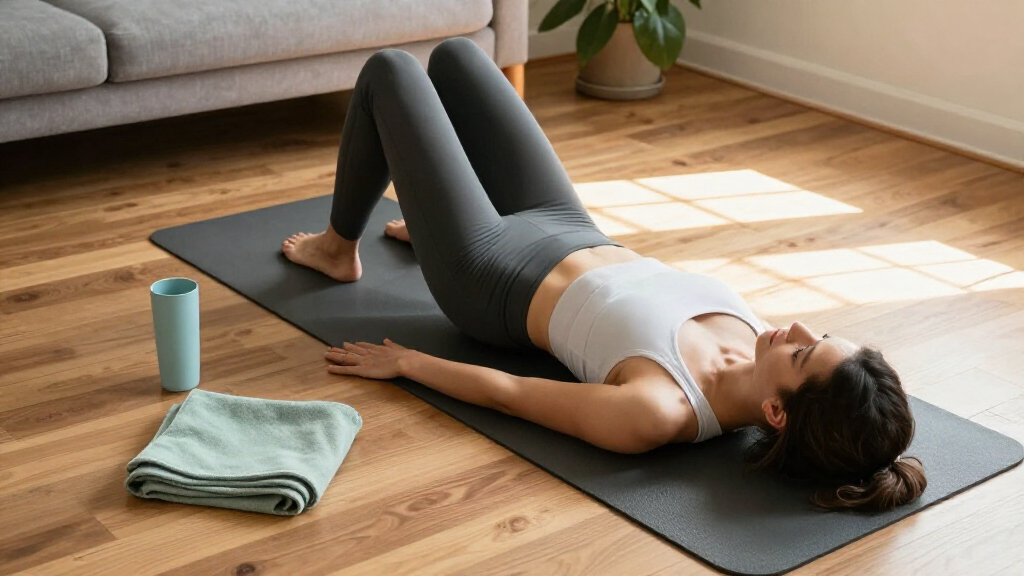
To begin, lie on your back and bring your legs into tabletop position: knees bent at 90 degrees and positioned above the hips. Before moving, settle the lower back toward the floor. Palmiero’s cues, as reported by Fit&Well, include drawing the belly button in and down and bringing the rib cage toward the hips. The source calls this setting the lower back into an “imprinted” position.
Inhale to prepare. As you exhale, lower one foot from the hip until the toes lightly tap the floor; inhale as you bring the leg back to tabletop. Repeat on the other side, alternating for 45 to 60 seconds. The main form point is to keep the pelvis and spine stable rather than allowing the lower back to lift or arch. Palmiero advises moving slowly and focusing on control instead of counting repetitions.
Breathing is part of the instruction, not an afterthought: Palmiero tells Fit&Well that people often forget to breathe during Pilates and says breath can help them engage their core and muscles. She suggests adding difficulty only after single-leg taps can be performed with control. Possible progressions include extending the leg during each tap, moving both legs together, or lifting the chest into a curl-up. The report also relays her suggestion to fit in at least one Pilates session a week, including for people who run or attend the gym; that is her advice, not a result from a study presented in the article.
A No-Equipment Entry Point
The recommendation offers beginners a simple way to practise core control at home without access to a reformer or a class. The movement’s small range and clear starting position can make it easier to focus on breathing and spinal stability before trying more complex Pilates exercises. For readers who already exercise, it is also presented as a potential addition to an existing routine rather than a replacement for running or strength training.
Fit&Well describes Pilates as supporting core strength, posture, balance and coordination, and says it can complement other forms of exercise. Those broad benefits are background claims in the report; the provided material does not include research citations, outcome data, or evidence that this single exercise prevents injury or rehabilitates a specific condition. Readers should treat Palmiero’s exercise guidance as instruction from an instructor, not as individualized medical advice.
Products Worth Considering

Garmin Venu 3S GPS Fitness Smartwatch, 41 mm, French Gray

Withings ScanWatch Light Hybrid Smartwatch – White

Philips Sonicare DiamondClean 9500 Electric Toothbrush, Black, with 3 Brush Heads
As an affiliate, we earn on qualifying purchases.
The Exercise Behind the Advice
The report focuses on one movement rather than requiring a beginner to start with specialist equipment. Palmiero identifies it as a “supine toe tap,” while noting that people may use different names for the exercise. It is performed on the floor in a supine, or face-up, position, with alternating foot taps from tabletop.
Palmiero is identified by Fit&Well as a certified mat and reformer Pilates instructor, head trainer at FS8 Chelsea Harbour, and athletics lead for FS8 in the UK and Europe. The article presents her guidance as an instructor’s recommendation. It does not report a new clinical study, formal exercise guideline, or independently measured finding; its news value is a practical, accessible starting suggestion for people unsure how to begin Pilates.
“I call it a supine toe tap but there are likely many different ways to describe it.”
— Amelia Palmiero, FS8 reformer and mat Pilates instructor, speaking to Fit&Well
Evidence and Individual Suitability
The supplied report does not give a publication date, link to supporting research, or measures of how the exercise affects strength, posture, or injury risk. Its statements about Pilates benefits are not quantified in the material, and Palmiero’s suggested weekly frequency is personal instructor guidance rather than a formal standard. The report also does not specify modifications for people with pain, pregnancy, recent surgery, or other health concerns.
People who experience pain or cannot keep a comfortable position should stop rather than push through the movement. Anyone with an injury, a health condition, or uncertainty about whether the exercise is suitable can seek guidance from a qualified health professional or Pilates instructor. The source does not establish that the toe tap treats or prevents any medical condition.
Build Control Before Progressing
The next step in Palmiero’s guidance is to practise the alternating taps while maintaining a steady lower back and pelvis, then consider a progression only when that control is consistent for the suggested 45 to 60 seconds. Readers can use the Fit&Well instructions as a starting reference, but the report does not announce a follow-up study, program, or scheduled development. Any broader claims about Pilates outcomes would require additional evidence beyond the instructor advice presented here.
Key Questions
What is a supine toe tap?
It is a mat-based movement performed lying on your back with your legs in tabletop. You lower one foot to tap the floor, return it to tabletop, and alternate sides while keeping your pelvis and lower back steady.
How long should beginners do the exercise?
Palmiero’s instructions, reported by Fit&Well, suggest alternating sides for 45 to 60 seconds. The focus is controlled form, not reaching a particular number of repetitions.
How can the toe tap be made harder?
After you can maintain control during single-leg taps, Palmiero suggests extending the leg with each tap or moving both legs together. She also mentions adding a chest lift into a curl-up. These are progressions, not starting variations.
Does this exercise require a reformer?
No. The supine toe tap is performed on a mat or other suitable floor surface and does not require a reformer machine.
Is the exercise appropriate for everyone?
The report does not assess individual health circumstances or offer tailored modifications. Stop if the movement causes pain, and ask a qualified health professional or instructor for advice if you have an injury, a health condition, or concerns about suitability.
Source: fitandwell.com