
Choosing an at-home massage device comes down to a practical tradeoff: electric models do the repetitive work for you, while manual tools rely on your hands and body weight. Electric massage guns, shiatsu cushions, and foot massagers can offer adjustable settings and easier sessions, but they usually cost more, need charging or an outlet, and may feel too intense or bulky. Foam rollers, massage balls, and handheld rollers are simpler and often cheaper, though they require more effort and practice. Choose electric devices if convenience and repeatable power matter most; choose manual tools if you want a low-cost option with direct control. Neither category replaces medical care for persistent or unexplained pain.

Get wellness gear delivered free with Prime
- Fast, free delivery on millions of items
- Prime Video, Amazon Music and more included
- Member-only deals all year

Therabody Theragun Prime Plus Heated Deep Tissue Massage Gun, Black
- ✔ Brand: Therabody
- ✔ Model: Theragun Prime Plus
- ✔ Massage type: Deep tissue percussion

Therabody Theragun Sense 2nd Generation Percussion Massage Gun, Black
- ✔ Brand: Therabody
- ✔ Model: Theragun Sense, 2nd Generation
- ✔ Battery life: Up to 2 hours
Therabody Theragun PRO Plus 6-in-1 Deep Tissue Massage Gun, Black
- ✔ Brand: Therabody
- ✔ Model: Theragun PRO Plus
- ✔ Massage type: Deep tissue massage
At a Glance
| Criteria | Electric massage devices | Manual massage tools | Winner |
|---|---|---|---|
| Upfront cost | Usually higher; prices vary widely by device type and features | Usually lower, with basic rollers and balls often among the least expensive choices | B |
| Effort and convenience | Powered operation reduces effort, though setup, charging, and positioning still take time | Requires active movement, pressure, or hand positioning throughout a session | A |
| Pressure and control | Adjustable settings offer repeatable intensity, but power can be difficult to moderate on sensitive areas | Direct feedback makes it easier to adjust pressure moment by moment | B |
| Coverage and target areas | Specialized shapes and attachments target particular muscles or body areas | A few simple tools can cover many areas, though some locations are harder to reach alone | Depends |
| Portability and storage | Varies: compact handheld devices travel well; cushions and foot units take more space | Often lightweight and easy to store; rollers can be awkward to pack | B |
| Power and maintenance | May need charging, power, cleaning, and care for moving parts | No charging or electronics; surfaces still need cleaning and tools may wear out | B |
| Best fit for frequent use | Useful when convenience encourages regular sessions and the device suits the user’s needs | Works well for users willing and able to apply the effort consistently | Depends |
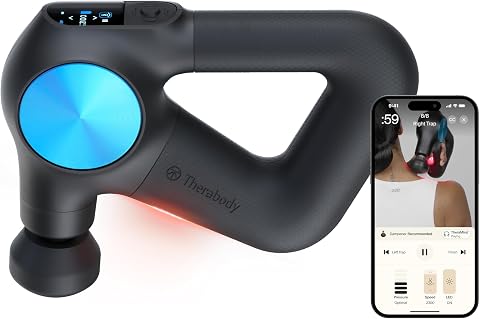
Therabody Theragun Prime Plus Heated Deep Tissue Massage Gun, Black
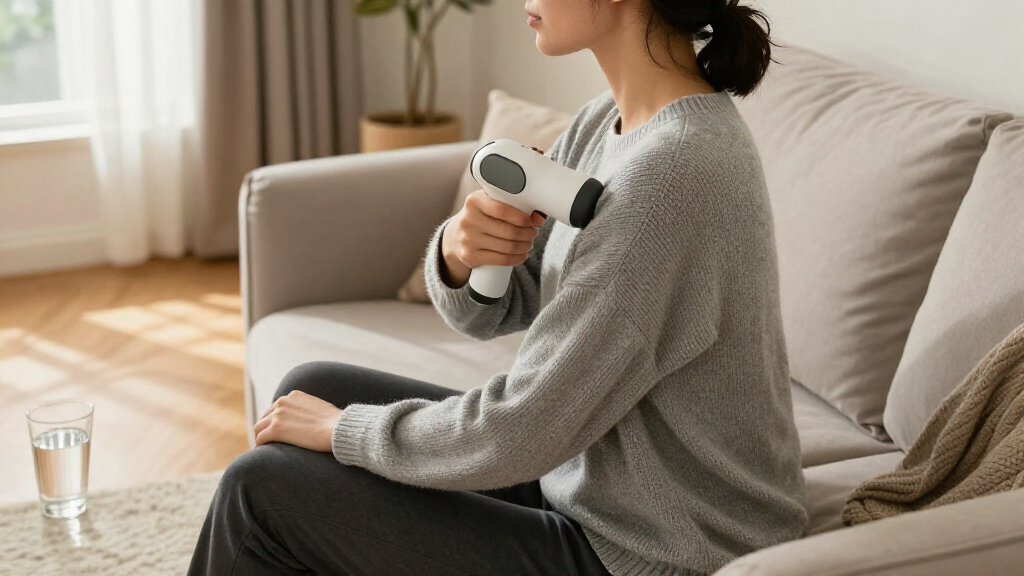
The Theragun Prime Plus earns our overall spot because it makes one useful at-home distinction easy to understand: choose a percussion speed, then add one of three heat settings when warmth is part of the routine. Five speeds give us room to adjust the feel, and the triangular grip is designed to support self-treatment across different body areas. Four included attachments also provide more starting options than the two supplied with Sense.Compared with the Sense 2nd Generation, Prime Plus puts more emphasis on heat and included attachments than on guided feedback. Sense has a screen with pressure feedback and four built-in routines, making it the better match for someone who wants coaching cues. Prime Plus instead connects to the Therabody app for guided routines, so a phone is part of that experience. It is less expansive than the PRO Plus therapy mix, which adds vibration and breathwork, but that broader menu may be unnecessary if our priority is a straightforward heated massage gun.The tradeoff is that the supplied feature set does not include every compatible therapy attachment: Cold Plus and Vibration Plus are separate add-ons. Buyers should also expect to use the app if they want guided routines. This model makes the most sense for people who want heat built into their regular percussion sessions, while those who value visible pressure cues or a broad therapy menu should compare Sense and PRO Plus first.
Pros:
- Combines percussion massage with three heat settings.
- Five speeds allow treatment intensity to be adjusted.
- Triangular design and non-slip grip support self-treatment.
- Four attachments are included.
Cons:
- Cold Plus and Vibration Plus attachments are compatible add-ons, not included.
- Guided routines require the Therabody app.
Best for: People who want adjustable percussion with built-in heat and a triangular grip for self-massage at home.
Not ideal for: Buyers who want on-device guided routines, pressure feedback, or cold and vibration attachments included.
Bottom line: Choose Prime Plus if built-in heat and a versatile set of attachments matter more to us than on-device coaching or a wider therapy menu.
“Choose Prime Plus if built-in heat and a versatile set of attachments matter more to us than on-device coaching or a wider therapy menu.”
Therabody Theragun Sense 2nd Generation Percussion Massage Gun, Black
Sense is the lineup’s most approachable option for buyers who want cues while learning how to use a percussion device. Its LCD screen displays three levels of pressure feedback, and four guided routines are built into the device. That means we can follow a routine without first opening the app; Bluetooth adds access to more routines and personalized recovery recommendations for those who want them.Against Prime Plus, Sense trades built-in heat and four included attachments for a more explicit guidance system. It has five speed settings, a quiet adaptive motor according to the product description, and two attachments: a Dampener and Standard Ball. The triangle grip is designed to improve reach and leverage, while stated battery life of up to two hours may suit repeat sessions between charges. These features give Sense a distinct role for buyers who want structure and adjustable pressure rather than the warmth-focused experience of Prime Plus.Compared with PRO Plus, Sense keeps the focus on percussion and routine guidance instead of adding vibration and breathwork. Its limitations are clear: only two attachments come in the box, and extra app routines require a Bluetooth-connected phone. The description identifies it as an FDA-registered medical device, but that designation does not tell us whether it is appropriate for a particular condition. Sense is best for people who value feedback and built-in guidance; buyers who already know the settings they want may prefer Prime Plus’s heat or PRO Plus’s broader modes.
Pros:
- Four built-in routines can be followed on the device.
- Three pressure feedback levels and five speeds support adjustment.
- Triangle grip is designed to improve reach and leverage.
- Includes a Dampener and Standard Ball attachment.
Cons:
- Only two attachments are included, fewer than Prime Plus.
- Additional app routines and recommendations require a Bluetooth-connected phone.
Best for: Newer percussion-massage users who want built-in routines, visible pressure cues, and a grip designed for reach.
Not ideal for: People who want heat included, a larger attachment selection, or the broad therapy mix of PRO Plus.
Bottom line: Pick Sense if guidance and pressure feedback will help us use a massage gun more comfortably and consistently.
“Pick Sense if guidance and pressure feedback will help us use a massage gun more comfortably and consistently.”
Therabody Theragun PRO Plus 6-in-1 Deep Tissue Massage Gun, Black
The Theragun PRO Plus is the most ambitious choice here for buyers who want more than percussion in their at-home recovery routine. The stated modes combine deep tissue massage with vibration, heat, and breathwork, while cold therapy is available separately. That variety gives it a broader role than Prime Plus, whose key addition is heat, or Sense, which puts its emphasis on built-in routines and pressure feedback.That breadth is useful when we expect to switch between different kinds of sessions and want one device to support them. It also asks us to be selective: a longer list of modes only helps if we will use them. The supplied description does not detail the PRO Plus controls, included attachments, battery life, or grip design, so we cannot compare those practical points with the specified four attachments on Prime Plus or Sense’s screen and routine cues. For buyers choosing by known details, that uncertainty makes the other two easier to match to a specific habit.There are two concrete setup considerations. Cold therapy is sold separately, and the box includes a USB-C charging cable but no power adapter. Compared with Sense, PRO Plus offers more therapy types but less detail about on-device guidance; compared with Prime Plus, it expands beyond heat but has a charging accessory caveat. This is the right fit for buyers who will make use of a multi-mode routine and are comfortable checking their charging setup, rather than someone looking for the simplest path to guided percussion.
Pros:
- Combines several therapy modes in one device.
- Includes deep tissue massage, vibration, heat, and breathwork.
- Cold therapy is available as a separately sold option.
- A USB-C charging cable is included.
Cons:
- Cold therapy is sold separately.
- Power adapter is not included.
- The supplied details do not specify included attachments or battery life.
Best for: People who want percussion plus vibration, heat, and breathwork as part of a varied home recovery routine.
Not ideal for: Buyers who want cold therapy included, a supplied power adapter, or detailed on-device pressure and routine guidance.
Bottom line: Choose PRO Plus if we will use its broader therapy mix and are prepared for separately sourced cold therapy and power adapter.
“Choose PRO Plus if we will use its broader therapy mix and are prepared for separately sourced cold therapy and power adapter.”
As an Amazon Associate we earn from qualifying purchases.
Key Differences
The clearest difference is who supplies the effort. Electric devices can make a massage session easier to start and repeat, especially when a user wants a powered hand-held tool or a device designed for a particular area. Their settings can provide consistent operation, but the sensation may still be strong, and a motor does not guarantee a comfortable or suitable massage. Manual tools require more involvement. That can be a drawback after a tiring day, yet it gives the user immediate feedback and control over where and how much pressure is applied.
Cost and versatility also pull in opposite directions. A basic manual roller or ball is a relatively inexpensive way to try self-massage and can be used on different body areas. Electric products span a wide range: a compact handheld device and a full-size massage chair are very different purchases, with different space and cost demands. Paying more makes sense when a particular device fits a regular routine and solves a clear access or convenience problem. It makes less sense to buy extra power or features without knowing whether the sensation, form factor, and target area suit you.
For most beginners who want an affordable way to explore self-massage, a manual tool is the safer value starting point. Electric devices are a better fit when reduced effort is the deciding factor and the buyer can choose a model with appropriate settings. People with health conditions, recent injuries, reduced sensation, or persistent pain should seek professional guidance before using vigorous massage tools.
Detailed Comparison
Upfront cost (Manual massage tools wins — major)
Manual tools generally win by a clear margin: a simple roller or ball costs less than most powered devices and can serve as an inexpensive first purchase. Electric models vary considerably, but their motors and added features raise the entry price. The gap is major for budget-conscious buyers; paying more is justified only when powered use addresses a real need.Effort and convenience (Electric massage devices wins — major)
Electric devices win because the motor supplies much of the repetitive motion, making a short session easier for users who find rolling or pressing tiring. They still require positioning and, for rechargeable models, charging. Manual tools demand active movement and pressure throughout. The difference is moderate to major for users with limited energy or who are more likely to stick to a low-effort routine.Pressure and control (Manual massage tools wins — moderate)
Manual tools win on immediate control: users can ease off or shift position based on what they feel. Electric models may offer multiple speeds, but their vibration or percussion can feel forceful, and settings do not replace careful placement. The gap is moderate, especially for beginners or anyone sensitive to pressure.Coverage and target areas (moderate difference)
This depends on the device. A manual ball or roller can be repositioned across multiple areas, while a specialized electric cushion, foot unit, or attachment may be more convenient for a specific target. Neither category automatically reaches every area comfortably, particularly without help. Match the device shape and instructions to the intended body area; the difference is moderate and use-specific.Portability and storage (Manual massage tools wins — minor)
Manual tools usually win because they are light, simple, and do not need a charger. Compact electric massagers travel reasonably well, but larger cushions and powered units occupy more space and may need an outlet. This is a minor difference for home use and a moderate one for frequent travel or cramped storage.Power and maintenance (Manual massage tools wins — minor)
Manual tools win on simplicity: there is no motor, battery, or power cord to manage, though the surface still needs cleaning and the tool may wear. Electric devices need appropriate charging or power and can have moving parts that require care. The difference is usually minor, but it matters if a user wants a device ready without setup.Fit for frequent use (moderate difference)
There is no universal winner. Electric models may make regular sessions more convenient, while manual tools are cheaper and let users vary pressure directly. The better option is the one the user can comfortably operate and will use consistently. A buyer should consider the intended area, effort, storage, and sensation before paying for a device meant for daily use.Electric massage devices: Pros and Cons
Pros:
- Powered operation reduces the effort needed during a session.
- Many models offer settings or attachments for different sensations or target areas.
- Can suit users who find manual rolling tiring.
Cons:
- Usually costs more than a basic manual tool.
- Needs charging or access to power, depending on the model.
- Powerful sensations or a poor fit may make a device uncomfortable or unsuitable.
Manual massage tools: Pros and Cons
Pros:
- Generally affordable and simple to start using.
- Direct pressure feedback makes it easy to adjust or stop.
- Lightweight options need no batteries, charging, or outlet.
Cons:
- Requires active effort and positioning.
- Some areas can be difficult to reach without assistance.
- Less convenient for users who want a repeatable powered sensation.
Who Should Choose What
Choose Electric massage devices if:
- You want a lower-effort session and have identified a specific body area or device style that suits you.
- You are more likely to use a powered device regularly than a roller or ball.
- You value adjustable powered operation and accept the higher cost and maintenance.
Choose Manual massage tools if:
- You are trying self-massage for the first time and want to spend less.
- You want direct control over pressure and an easy-to-store tool.
- You prefer a simple device with no charging or motor.
Skip both if: You have persistent, unexplained, or worsening pain, or a condition that makes massage unsafe without professional advice; seek guidance from a qualified health professional first.
Value for Money
Manual tools are usually the better value for a first purchase because they cost less, cover several uses, and let you learn what pressure and placement feel comfortable. An electric device can be worth the extra cost when reduced effort makes the difference between using a tool regularly and leaving it unused, or when a particular powered design fits a specific need. Compare the actual device, not just the category: a compact massager and a large powered chair have very different prices, storage needs, and capabilities. Pay more for a feature you expect to use, not simply for more power or a longer feature list.
Final Verdict
For most people exploring at-home massage, start with a basic manual roller or ball: it is inexpensive, portable, and gives direct control over pressure. Choose an electric massage device if convenience is your main concern, manual effort limits your use, and you have found a model suited to the area you want to address. The biggest deciding factor is whether you value low-effort powered operation enough to justify its cost and upkeep. If you are unsure, buy the simpler manual tool first; if it proves too demanding to use consistently, a targeted electric device may be worth the upgrade.
Frequently Asked Questions
Are electric massage devices better than manual tools?
Neither is better for everyone. Electric devices reduce effort and can provide repeatable settings; manual tools cost less and offer immediate pressure control. The better choice depends on comfort, intended use, and willingness to apply effort.
Is an electric massage device worth paying more for?
It can be worth the higher cost if powered operation helps you use it regularly or a specific design fits your needs. If you are exploring self-massage or value simplicity, a manual roller or ball is usually a better first purchase.
Which type is better for beginners?
A basic manual tool is often a sensible starting point because it is inexpensive and easy to adjust by feel. Beginners choosing an electric model should start with low intensity, follow the instructions, and stop if the sensation is painful or uncomfortable.
Can a massage device treat chronic pain?
Massage devices may offer temporary comfort for some users, but they do not diagnose or treat the cause of persistent pain. Ask a qualified health professional for advice, especially if pain is worsening or accompanied by other symptoms.