TL;DR

Get wellness gear delivered free with Prime
- Fast, free delivery on millions of items
- Prime Video, Amazon Music and more included
- Member-only deals all year
Physical therapist Devin Trachman recommends the sit-to-stand exercise as a way to build strength used in walking and other daily activities. Her suggested starting plan is two to three sets of eight to 10 repetitions, with chair support or hand assistance if needed.
Physical therapist Devin Trachman recommends the sit-to-stand exercise as a starting point for people seeking to build strength that supports walking and everyday mobility. In a Fit&Well report, Trachman said the movement trains lower-body muscles used to rise from a chair, climb stairs and walk; it is a practical exercise suggestion, not a guarantee that walking ability will improve for every person.
Trachman, identified by Fit&Well as a clinical director and physical therapist at Physical Therapy Central, recommends two to three sets of eight to 10 repetitions, with about 60 seconds of rest between sets. The exercise involves sitting near the front of a sturdy chair, placing both feet flat on the floor about shoulder-width apart, leaning the chest slightly forward while keeping the back straight, and standing by pushing through the heels. The person then lowers back into the seat with control.
The report says sit-to-stands target the quadriceps, gluteus maximus and core stabilizers. Trachman describes standing up from a chair as a functional movement used regularly in daily life. She advises avoiding hand support if possible, but says people who need assistance can use a chair with armrests or a sturdy support in front of them while developing strength.
Fit&Well frames the exercise in the context of changes some people notice as they age, including reduced muscle mass and mobility. Trachman says less activity can contribute to weaker muscles, reduced balance and lower endurance, making walking feel harder. The source does not report a clinical trial or new study testing the exercise; the recommendation is presented as the physical therapist’s professional guidance.
Building Strength for Everyday Walking
The recommendation focuses on a movement people already perform in ordinary life, making it a relatively accessible way to practice lower-body strength. The muscles involved in standing from a chair also contribute to other daily tasks, including walking and climbing stairs. For readers who find longer walks tiring or want to maintain mobility, the exercise may offer a way to work on strength without starting with a walking-distance goal.
Trachman’s broader point is that activity and confidence can be linked: when walking feels more difficult, people may do less of it, and reduced activity can leave them feeling less strong or steady. She says gentle strength training may help address that cycle. That is her clinical perspective as quoted in the report, not evidence that sit-to-stands alone prevent falls, restore independence or treat a medical condition. People with pain, balance problems or health concerns may need an exercise plan tailored to them.
sturdy chair for sit-to-stand exercises
As an affiliate, we earn on qualifying purchases.
As an affiliate, we earn on qualifying purchases.
The Chair-Rise Exercise Explained
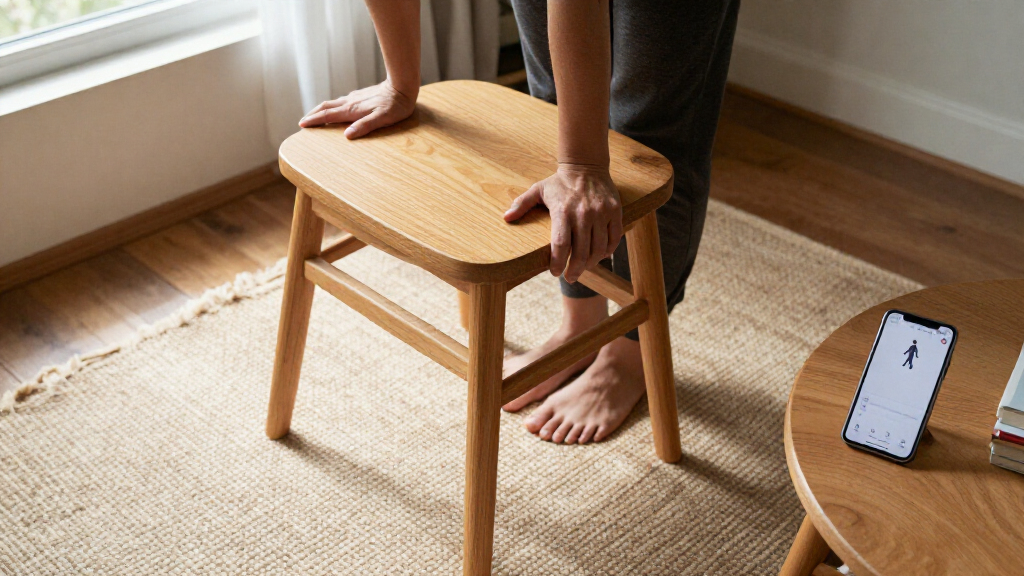
To perform a sit-to-stand, use a sturdy, stable chair and begin seated with feet flat and spaced about shoulder-width apart. Lean forward slightly from the hips while keeping the back straight, then press through the heels to stand upright. Return to sitting slowly and with control rather than dropping into the chair. The suggested routine is eight to 10 repetitions per set, repeated for two or three sets, with 60 seconds of rest.
The report recommends keeping the hands off the chair when that is manageable, but it also provides modifications. A person who needs help can use armrests for light support or place a table or other sturdy support in front of them. These options are presented as ways to make the movement more manageable, rather than requirements to progress to a hands-free version. Trachman’s background, as stated by Fit&Well, includes a Doctor of Physical Therapy degree and board certification as an orthopaedic clinical specialist in 2024.
“If I could only prescribe one exercise to improve walking, this would be it.”
— Devin Trachman, physical therapist, as quoted by Fit&Well
exercise resistance bands for lower body
As an affiliate, we earn on qualifying purchases.
As an affiliate, we earn on qualifying purchases.
What the Recommendation Does Not Establish
The Fit&Well report does not identify a study comparing sit-to-stands with other exercises, nor does it provide outcome data showing how much the movement changes walking speed, distance, balance or independence. The recommendation is attributed to Trachman and should be understood as professional advice rather than a measured result. It is also unclear from the source how often the routine should be done each week or how long a person should follow it before changing the repetitions or difficulty.
The source does not specify which readers should avoid the exercise or how to adapt it for particular diagnoses, injuries or levels of mobility. Anyone who experiences pain, feels unsteady, or has a health condition affecting exercise may want guidance from a qualified clinician before starting. The report offers chair and hand-support modifications, but does not provide individualized assessment.
As an affiliate, we earn on qualifying purchases.
Starting With a Stable Chair
The next step described in the report is a simple, supported version of the movement: use a stable chair, complete a manageable number of controlled repetitions, and use armrests or a sturdy support if needed. Trachman’s suggested range is two to three sets of eight to 10 repetitions, resting about a minute between sets. The report does not set out a progression schedule or say when to increase the workload.
Readers seeking a routine suited to their ability can ask a physical therapist or other qualified health professional for advice, particularly if pain, balance limitations or an existing condition affect movement. Fit&Well’s article presents sit-to-stands as one recommended exercise, while the amount of benefit and the right plan for any individual remain dependent on their circumstances.
As an affiliate, we earn on qualifying purchases.
Key Questions
Which exercise did Devin Trachman recommend?
She recommended the sit-to-stand: rising from a chair and lowering back into it with control.
How many sit-to-stands does the report suggest?
The suggested routine is two to three sets of eight to 10 repetitions, with about 60 seconds of rest between sets.
Can someone use their hands for support?
Yes. Trachman’s guidance, as reported by Fit&Well, suggests using a chair with armrests for light support or a sturdy support in front if standing without help is difficult.
Does the report prove sit-to-stands improve walking?
No. The source presents Trachman’s clinical recommendation but does not report a study or measured results showing how much the exercise changes walking ability.
Source: rss
Cold & flu season Picks
humidifiers
As an affiliate, we earn on qualifying purchases.