TL;DR

Get wellness gear delivered free with Prime
- Fast, free delivery on millions of items
- Prime Video, Amazon Music and more included
- Member-only deals all year
A Fit&Well report features a trainer who incorporates three coordination exercises into sessions with older adults: opposite arm-and-knee raises, side steps with an opposite-arm reach, and a ball-throwing drill. The trainer says the movements can be adapted for seated practice; the report cites a 2019 review linking balance and coordination exercises with improvements in some cognitive processes and postural control.
Fit&Well has published a trainer’s account of three coordination exercises she uses with older adults, saying she includes them in chair-based yoga classes and personal training. The movements pair actions across the body or add a ball-catching task, and the report describes seated alternatives for people who do not exercise standing.
The trainer says coordination work is part of her sessions because it asks participants to coordinate different movements and focus on the connection between thought and movement. She says clients use the exercises to practise everyday movements, such as navigating around people on public transport or managing more than one task at home. Those are the trainer’s reasons for including the drills, not findings from a specific assessment of the clients.
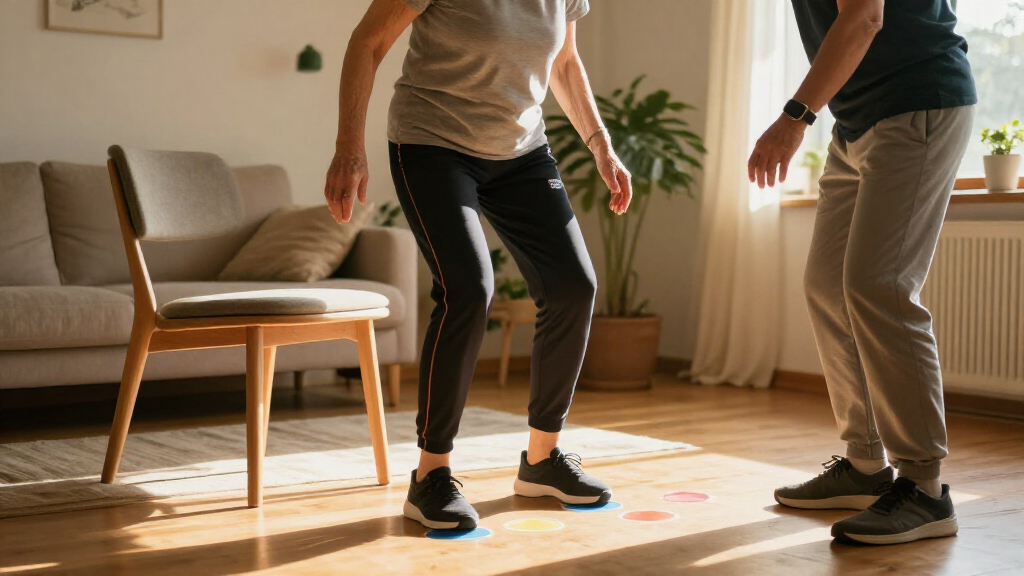
The first exercise is a knee raise with the opposite arm. Standing with feet hip-width apart and arms out at shoulder height, a participant raises one knee while moving the opposite arm forward, then alternates sides. The report suggests five to six repetitions per side. Its seated option is a slow seated march, raising the opposite arm in front or overhead with each knee lift.
The second drill pairs a side step with an opposite-arm reach. Participants step to one side and reach the other arm forward, returning to the starting position before switching sides. A small side lunge is optional; the report recommends five to six repetitions per side. Seated participants can step one foot out and open the opposite arm to the side. The third exercise uses a ball: from a few steps away from a wall, a participant throws it underhand, then catches it while balancing on one leg. The source suggests five to 10 throws and says the drill can be made easier by standing on both feet or sitting down.
Coordination in Everyday Movement
The report puts forward coordination as a complement to strength training, rather than a replacement for it. Its practical emphasis is on combining movements, responding to a moving object and adjusting balance—skills the trainer says relate to ordinary activities. That framing may be useful to older readers looking for exercise ideas that can be changed to suit their current mobility.
The suggested seated versions also make clear that the drills are not presented as a single fixed routine for everyone. The source describes options to reduce the balance challenge, including performing the ball exercise seated or using both feet on the floor. Readers should choose a version appropriate to their ability and use support or professional guidance if they have health or mobility concerns. The report does not establish that these specific exercises prevent falls, treat cognitive conditions or extend life.
lightweight soft exercise ball for seniors coordination exercises
As an affiliate, we earn on qualifying purchases.
As an affiliate, we earn on qualifying purchases.
How the Trainer Uses the Drills
The Fit&Well article places coordination work alongside strength training, which it describes as a familiar part of discussions about ageing well. The trainer says she incorporates coordination into both chair-based yoga classes and personal-training sessions with older adults. She varies the exercises: some clients perform standing versions, sometimes combined with balancing movements, while others work seated.
As evidence, the report refers to a 2019 review of balance and coordination exercises in older adults. It says the review found improvements in cognitive processes such as spatial awareness, as well as postural control and stability in distracting environments. The source does not provide the review’s title, authors, participant numbers, effect sizes or details about how the findings apply to the three exercises described. The review is cited as general support for this type of training, not as a trial of this trainer’s routine.
““I always incorporate coordination training into my chair-based yoga classes and personal training sessions with older adults.””
— The trainer featured in Fit&Well
sturdy chair with arms for seated exercises seniors
As an affiliate, we earn on qualifying purchases.
As an affiliate, we earn on qualifying purchases.
What the Evidence Does Not Establish
The source does not give enough detail to independently evaluate the 2019 review or determine how large or durable the reported improvements were. It also does not establish whether the three drills in the article were tested together, how often older adults should perform them, or whether they improve outcomes such as fall rates or independence.
The account is based on a trainer’s practice and general research cited by the publication. It does not include client outcome data, a comparison group or advice tailored to a reader’s medical history. The appropriate level of challenge for someone with balance difficulties or other health conditions is not specified.
non-slip exercise mat for balance exercises seniors
As an affiliate, we earn on qualifying purchases.
As an affiliate, we earn on qualifying purchases.
Adapting the Routine Safely
The article presents the exercises as options to adapt, not as a prescribed programme. Readers interested in trying them can begin with the seated versions or a stable two-foot stance, and avoid adding a lunge or single-leg balance challenge unless it is comfortable and safe for them. Anyone with a health condition, a history of falls or uncertainty about suitable movement can ask a qualified health or exercise professional for guidance.
No further study, publication or follow-up from the trainer is announced in the source material. The next useful evidence would include details about the cited review and research testing specific coordination routines, including the frequency and duration of practice and outcomes for older adults.
resistance-free home exercise equipment for older adults
As an affiliate, we earn on qualifying purchases.
As an affiliate, we earn on qualifying purchases.
Key Questions
Which coordination exercises does the report describe?
It describes opposite arm-and-knee raises, side steps paired with an opposite-arm reach, and a ball throw-and-catch drill performed while balancing.
Can the exercises be done seated?
Yes. The report gives seated versions of all three: a controlled march with the opposite arm, a seated side step with an arm opening, and a seated ball throw-and-catch option.
What does the cited 2019 review say?
As summarized in the Fit&Well report, the review found that balance and coordination exercises in older adults can improve some cognitive processes, including spatial awareness, and measures of postural control and stability. The article does not provide enough bibliographic or methodological detail to assess the findings further.
Does the report show that these exercises prevent falls or extend life?
No. It describes a trainer’s approach and cites broader research on balance and coordination. It does not establish that these specific exercises prevent falls, extend life or produce a particular health outcome.
Source: rss
Cold & flu season Picks
humidifiers
As an affiliate, we earn on qualifying purchases.