TL;DR

Get wellness gear delivered free with Prime
- Fast, free delivery on millions of items
- Prime Video, Amazon Music and more included
- Member-only deals all year
Fit&Well published five Pilates exercises recommended by instructor Claire Seager for women in their 60s and 70s: rocking cat and cow, reverse tabletop, knee circles, triceps push-up and thread the needle. The report describes them as options for strength, flexibility and posture, but provides no study data showing that the routine corrects posture or works for everyone.
Fit&Well has published five beginner-friendly Pilates moves recommended for women in their 60s and 70s who want to work on strength, flexibility and posture. Instructor Claire Seager, founder of Pilatify, supplied the exercises and easier variations; the report presents them as suggestions, not as a clinically tested program or a guarantee of posture correction.
The five moves are rocking cat and cow, reverse tabletop, knee circles, triceps push-up and thread the needle. Seager described her selection as a blend of strength, flexibility and posture work. The prescribed repetition counts range from 10 to 10 per side or direction, depending on the exercise.
For rocking cat and cow, begin on hands and knees, round the spine, rock gently toward the heels and return before arching the back. Reverse tabletop starts seated, with hands behind the body; lift the hips and lower with control. For knee circles, stay on all fours and draw circles with one bent leg while trying to keep the pelvis steady. Seager suggests lifting and lowering the knee instead if circles make the pelvis shift.
The triceps push-up is performed from a plank, with elbows kept close to the sides; the easier version keeps the knees down. For thread the needle, from hands and knees, extend one leg behind to hip height, then pass the same-side arm underneath the torso and rotate. The report’s modification is to keep both knees on the floor. These alternatives reduce the demands of the movements, but the report does not give individualized medical advice.
A Lower-Impact Strength Option
The routine offers readers who prefer not to lift heavy weights or do high-impact cardio a set of movements they can adapt. Several exercises use body weight and can be made less demanding by changing the position or range of motion. That may make the list a practical starting point for someone seeking guided movement, rather than a measure of fitness or a replacement for a tailored exercise plan.
Seager says Pilates can support strength, balance and flexibility and may counter a forward-head or stooped posture. Those are the instructor’s descriptions of potential benefits; the source report does not cite research or track outcomes for this specific sequence. Readers should not interpret “posture correction” as a promise that these exercises will resolve pain or a medical condition.
Movement needs and balance vary from person to person, particularly with existing injuries, joint problems or other health concerns. A reader unsure whether a move is suitable can ask a health professional or a qualified instructor for guidance. Stop if an exercise causes pain, dizziness or unusual discomfort.
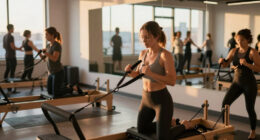
Pilates beginner exercise equipment for seniors
As an affiliate, we earn on qualifying purchases.
As an affiliate, we earn on qualifying purchases.
How the Routine Was Selected
The source is a Fit&Well exercise report focused on Pilates for women over 60. Its author turned to Seager, identified as a 51-year-old Pilates teacher and founder of Pilatify, a program designed with women over 50 in mind. Seager provided the five exercises and their beginner modifications.
The report distinguishes Pilates from a single fixed format, noting that modern classes vary and that some may be better suited to younger bodies. Its list is specifically presented for women in their 60s and 70s. It does not compare the exercises with other workouts, describe a complete weekly schedule or report participant outcomes.
“Pilates brings the whole body into balance and once we’ve worked one set of muscles, we will stretch them.”
— Claire Seager, Pilates teacher and founder of Pilatify, as quoted by Fit&Well
Posture correction aids for women over 60
As an affiliate, we earn on qualifying purchases.
As an affiliate, we earn on qualifying purchases.
What the Report Does Not Establish
The source does not provide a publication date, clinical evidence, participant results or a comparison showing how much strength or posture might change. It also does not specify how often readers should perform the sequence, how long to rest between sets, or how to progress over time. The exercises are recommendations from an instructor, and individual suitability cannot be determined from the article alone.
It remains unclear whether the sequence is appropriate for people with specific health conditions, pain, balance limitations or prior injuries. The report includes easier variations, but no screening process or detailed safety instructions. Readers with concerns should seek advice from a qualified health professional before starting or changing an exercise routine.
Low-impact Pilates resistance bands
As an affiliate, we earn on qualifying purchases.
As an affiliate, we earn on qualifying purchases.
How Readers Can Adapt the Moves
The report does not announce a follow-up study, scheduled class or additional development. Readers can use the published modifications to reduce the difficulty, but should begin within a comfortable range and avoid forcing a stretch or movement. Professional guidance is the next step for anyone uncertain about balance, joint comfort or whether a particular position is suitable.
Any assessment of whether the moves improve strength or posture would require evidence beyond the source report, such as measured outcomes over time. Until such information is available, the list is best understood as an instructor’s beginner-oriented exercise suggestion, not a proven treatment or a guaranteed result.
As an affiliate, we earn on qualifying purchases.
Key Questions
Which five Pilates moves does the report recommend?
It lists rocking cat and cow, reverse tabletop, knee circles, triceps push-up and thread the needle, with easier variations for each.
Are the exercises proven to correct posture?
No evidence for that claim is provided in the report. Seager says Pilates aims to counter a forward-head or stooped posture, but the article does not present research or measured results showing these five moves correct posture.
Can beginners make the moves easier?
Yes. The report suggests options such as skipping the rocking motion in cat and cow, bending the knees for reverse tabletop, and keeping the knees down for the triceps push-up or thread the needle.
Should someone with pain or a health condition try the routine?
The report does not assess individual medical needs. Anyone with pain, a prior injury, balance concerns or a health condition should consult a qualified health professional or instructor before starting, and stop if a movement causes discomfort.
Source: rss
Halloween Picks
halloween
As an affiliate, we earn on qualifying purchases.