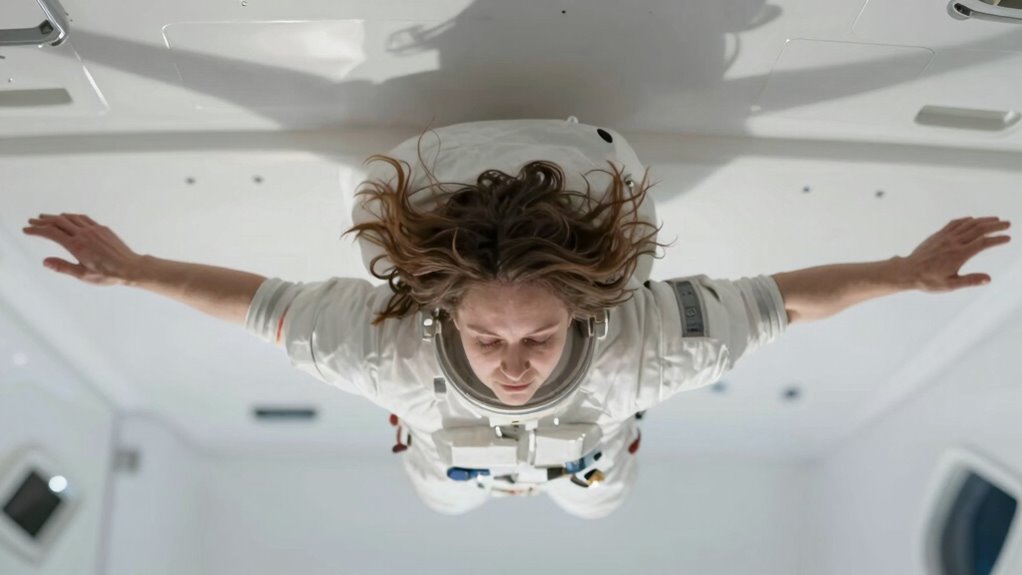

You feel weightless in zero gravity because your body no longer experiences the pull of Earth’s gravity, which normally keeps your muscles, fluids, and perception grounded. This environment changes how you move, balance, and react, making even simple tasks seem unfamiliar. Your body adapts by shifting fluids and weakening muscles, requiring special training and techniques to navigate. To understand why it feels so different and how humans adjust, keep exploring how this environment transforms perceptions and physical responses.

Get wellness gear delivered free with Prime
- Fast, free delivery on millions of items
- Prime Video, Amazon Music and more included
- Member-only deals all year
Key Takeaways
- Zero gravity is a scientific environment where weightlessness occurs due to free-fall conditions in space.
- The absence of gravity alters how the body moves, balances, and perceives spatial orientation.
- Initial disorientation arises because the brain’s usual cues for up and down are disrupted.
- Movement relies on pushing off surfaces and using handrails, making tasks feel different from Earth.
- Physiological changes, like fluid shifts and muscle weakening, contribute to the unique sensation of zero gravity.
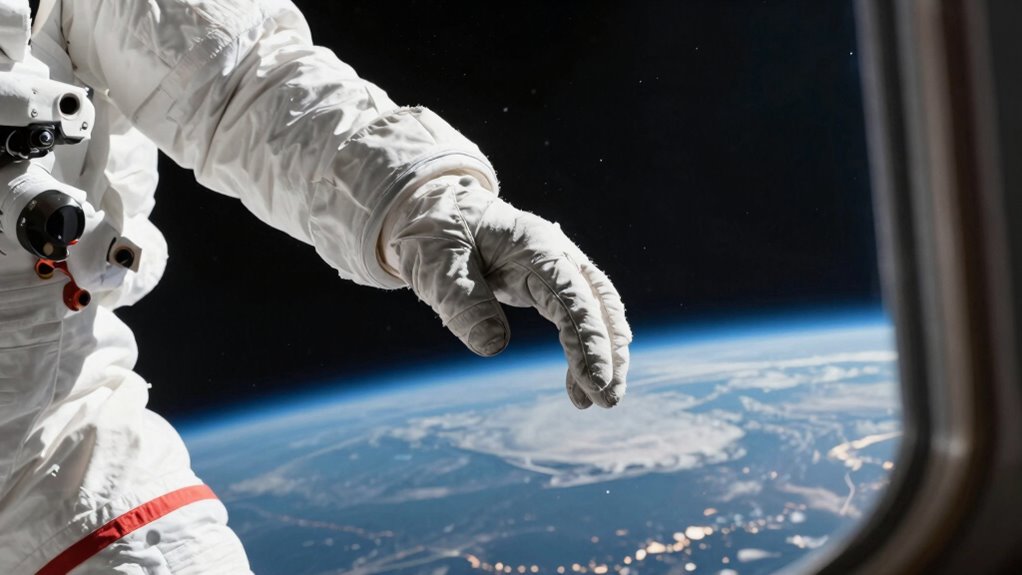
Have you ever wondered how the concept of zero gravity transformed from a theoretical idea into an essential part of space exploration? It’s a fascinating journey, one that begins with understanding how humans adapt to environments where gravity’s pull is almost nonexistent. When you step into the weightless world of space, everything changes—your movements, your sense of orientation, even how your body reacts. This shift is why astronauts undergo intense training to prepare for spacewalk challenges and life in zero gravity. Their training helps them grasp how their bodies will behave and what techniques they’ll need to maneuver effectively.
In space, the usual rules of gravity no longer apply, so simple tasks become complex. Moving around requires a different approach—you push off surfaces to glide, pull yourself along handrails, and learn to control your movements precisely. During spacewalks, or extravehicular activities, these challenges intensify. You often find yourself holding onto tools or tethered to the spacecraft, constantly adjusting your position in a way that feels unnatural at first. These spacewalk challenges demand rigorous astronaut training, emphasizing practice in simulators that mimic zero-gravity conditions. You learn how to handle tools, manage your buoyancy, and work efficiently without the pull of gravity to guide you. Without proper training, even routine tasks can become dangerous, risking injury or damage to spacecraft.
In zero gravity, astronauts push off, hold onto tools, and practice in simulators to master spacewalks safely.
Your body’s response to zero gravity is another vital aspect of understanding why this environment feels so different. In space, fluids shift toward your head, and muscles weaken because they’re no longer needed to support your weight. That’s why astronaut training includes strength exercises and simulations to counteract these effects. You’re taught how to move smoothly, conserve energy, and adapt your instincts to this weightless environment. Over time, your perception of up and down blurs, and your sense of balance adjusts, but the initial shift can be disorienting. That’s why thorough preparation is essential—so you’re not caught off guard when faced with spacewalk challenges or everyday tasks in zero gravity. Additionally, understanding the physiological effects of zero gravity helps scientists develop countermeasures to protect astronauts’ health during long missions.
Ultimately, the zero-gravity environment is not just a physical space but a mental adjustment. It’s why understanding its origins, from scientific theory to real-life application, is so compelling. Your ability to adapt hinges on rigorous astronaut training, which prepares you for the unique demands of space. The sensation of floating freely, the feeling that your body behaves differently, all stem from this extraordinary environment that once existed only in imagination but now is central to humanity’s exploration of the cosmos. Recognizing the science behind zero gravity reveals how crucial this environment is to advancing space technology and astronaut health.
As an affiliate, we earn on qualifying purchases.
Frequently Asked Questions
How Does Zero Gravity Affect the Human Body Long-Term?
Long-term zero gravity causes your muscles to weaken and atrophy because you don’t use them as much. Your bones also lose density, increasing fracture risk, since they don’t bear weight like on Earth. Over time, these changes can lead to mobility issues and health concerns. To counteract this, astronauts perform regular exercise routines to maintain muscle strength and bone density while in space.
What Challenges Do Astronauts Face Adapting to Zero Gravity?
You face significant space adaptation challenges when adjusting to zero gravity, as your body must relearn how to function without Earth’s pull. Gravity training helps prepare you, but initially, you might feel disoriented, struggle with balance, and experience muscle loss. Your bones weaken, and fluid shifts cause facial puffiness. Over time, your brain adapts, but the shift demands resilience, patience, and consistent training to thrive in this weightless environment.
Can Zero Gravity Impact Mental Health or Cognitive Function?
Zero gravity can impact your mental health and cognitive function by causing psychological effects like isolation, stress, and sleep disturbances. You might experience difficulties with cognitive adaptation, such as memory lapses and decreased focus. These changes happen because your brain adjusts to the new environment, but they can be challenging. Staying connected with loved ones and maintaining routines can help mitigate these effects, supporting your mental resilience during space missions.
How Is Zero Gravity Simulated on Earth for Research?
You can simulate zero gravity on Earth using spacecraft design and gravity simulation techniques like parabolic flight, neutral buoyancy, and clinostats. Parabolic flights create short periods of weightlessness, while neutral buoyancy tanks mimic microgravity by balancing buoyant and gravitational forces. Clinostats rotate objects or astronauts to simulate the effects of gravity, helping researchers study how zero gravity impacts humans and equipment without leaving Earth’s surface.
What Are the Potential Future Applications of Zero-Gravity Environments?
You could experience space tourism or zero-gravity training in the future, thanks to advancements in zero-gravity environments. These environments will allow you to simulate weightlessness for leisure, education, or astronaut training. As technology improves, expect more accessible zero-gravity experiences, opening doors for commercial space travel and innovative research. This evolution will make space more reachable, transforming how you prepare for missions and indulge in space-inspired adventures.
astronaut spacewalk training equipment
As an affiliate, we earn on qualifying purchases.
As an affiliate, we earn on qualifying purchases.
Conclusion
As you drift through the weightless expanse, you realize that zero gravity isn’t just a sensation—it’s a dance with the universe’s quiet, unseen forces. It rewires your sense of self, like a painter blending colors on a canvas, transforming familiar boundaries into shimmering horizons. In this delicate balance, you discover that floating isn’t merely an absence of weight but a profound reminder: sometimes, to truly understand ourselves, we must let go of everything holding us down and embrace the endless sky.
As an affiliate, we earn on qualifying purchases.
As an affiliate, we earn on qualifying purchases.
Fall Picks
fall essentials
As an affiliate, we earn on qualifying purchases.