Weightlessness feels good because zero gravity creates an effortless, buoyant environment where your muscles and joints relax fully, and movement becomes smooth and flowing. Without the pull of gravity, inertia guides your motions gently, reducing resistance and tension. This natural floatation diminishes muscular effort, promoting calmness and serenity. By understanding how physics shapes this sensation, you’ll discover why relaxing in zero-G feels so surprisingly soothing—keep going to learn even more.
Key Takeaways
- Zero gravity creates a feeling of effortless floating, reducing muscular effort and joint stiffness, promoting physical relaxation.
- The absence of gravitational pull eliminates body weight sensations, leading to a soothing, buoyant sensation.
- Inertia-driven, smooth movements in zero-G enhance comfort and decrease strain on muscles and joints.
- The lack of gravitational feedback causes the nervous system to recalibrate, resulting in a relaxed sense of spatial orientation.
- Overall, the diminished physical resistance and internal balance promote mental calmness and a profound sense of serenity.
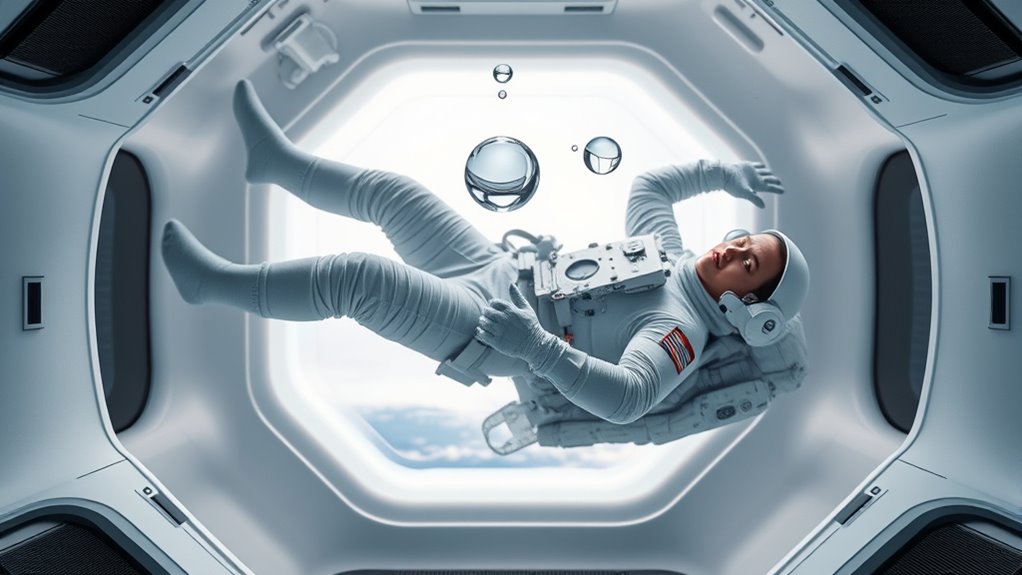
In the weightless environment of zero gravity, your body’s relaxation processes operate differently than on Earth. Without the constant pull of gravity, you experience a unique sensation—often described as a free fall sensation—that makes your body feel effortlessly buoyant. This sensation occurs because, in space, you and everything around you are in continuous free fall, creating an environment where gravity’s pull is effectively canceled out. As a result, your sense of weight diminishes, and your muscles and joints relax in ways they rarely do on solid ground. Rather than fighting against gravity, your body simply floats, feeling as if you’re suspended in midair.
This free fall sensation deeply influences how your body responds to movement and relaxation. Because there’s no gravitational force to pull your limbs downward, your muscles don’t need to work as hard to maintain posture or stability. Instead, inertia effects take center stage—your body’s tendency to resist changes in motion. When you move or stretch, the inertia effects become more noticeable; you feel smooth, almost effortless shifts rather than the resistance you’d encounter on Earth. This allows for a broader range of gentle, flowing motions, which can be deeply soothing and help your muscles relax more fully.
Your nervous system also adapts to this altered environment. Normally, gravity provides constant feedback about your body’s position, helping you coordinate movements and maintain balance. In zero-G, that feedback disappears, so your brain recalibrates its sense of spatial orientation. This recalibration reduces tension and strain, making relaxation easier. Movements that would require effort or cause discomfort on Earth—like stretching or twisting—become much more comfortable and natural. Because inertia effects promote smooth, continuous motion, you often find yourself moving with a gentle, flowing rhythm that promotes relaxation rather than resistance.
Furthermore, the absence of gravity means your internal organs and muscles aren’t constantly working to counteract downward pull. This reduces overall fatigue and allows your body to settle into a more restful state. The combination of a free fall sensation and inertia effects creates an environment where relaxation isn’t hindered by the usual muscular tension or joint stiffness caused by gravity. Instead, your body can simply float, stretch, and drift, experiencing a profound sense of ease. This unique physics environment not only helps you relax physically but can also promote mental calmness, as the sensations of weight and resistance fade away, leaving behind a pure, unencumbered feeling of serenity.
Frequently Asked Questions
How Does Zero Gravity Affect Muscle Mass Over Time?
In zero gravity, your muscles experience less resistance, leading to muscle atrophy over time. Without regular weight-bearing activities, your muscles weaken and shrink, causing physical deconditioning. You might notice decreased strength and endurance, as your body adapts to the low-gravity environment. To counteract this, astronauts perform resistance exercises daily, helping preserve muscle mass and prevent long-term health issues associated with muscle atrophy in space.
Can Astronauts Experience Motion Sickness in Weightlessness?
Imagine you’re experiencing space adaptation, where sensory disorientation can cause motion sickness in weightlessness. Yes, astronauts often feel nausea or dizziness, especially when adjusting to zero-G. Your inner ear struggles to interpret motion signals without gravity, leading to discomfort. It’s like being in a roller coaster that never stops, but with practice and time, your body adapts, and these symptoms usually diminish.
What Safety Measures Are in Place During Zero-G Relaxation?
During zero-g relaxation, spacewalk safety protocols are strict to prevent accidents, and emergency protocols are in place if issues arise. You’ll wear a tether to stay connected to the spacecraft, and trained astronauts monitor all activities. If an emergency occurs, quick procedures guarantee your safety, including oxygen supply checks and communication systems. These measures help you relax confidently, knowing safety is prioritized during every moment in zero-g.
How Does Zero-G Impact Blood Circulation and Heart Health?
Imagine your blood flow dynamics in zero-g, flowing smoothly and freely like a gentle stream without gravity’s pull. This environment prompts your cardiovascular system to adapt, causing fluids to shift and your heart to work differently. While it can boost circulation temporarily, prolonged zero-g exposure may challenge your heart’s ability to maintain normal blood pressure and circulation, requiring careful monitoring to guarantee your heart stays healthy during space adventures.
Are There Long-Term Psychological Effects of Weightlessness?
You might experience long-term psychological effects from weightlessness, such as improved psychological adaptation and increased stress resilience. Being in zero-G challenges your mental toughness, helping you develop better coping skills and adaptability. Over time, this environment can boost your confidence in handling stress and uncertainty, fostering a sense of calmness and mental flexibility. However, individual responses vary, and ongoing support is essential for maintaining mental well-being during extended space missions.
Conclusion
So, as you drift in zero-g, you discover the delightful dance of dynamics and damping. The physics of relaxation in weightlessness offers a wonderful way to unwind, unwind, and truly unplug. Feel the freedom of floating freely, feeling friction fade away, and stress soften. Zero-G’s gentle glide grants you a gratifying glimpse of gravity’s goodbyes, giving you a glorious gift of graceful, guilt-free relaxation. Embrace this extraordinary experience, and let physics perfectly pacify your peaceful part.