
TL;DR
A Fit&Well article describes a writer’s anterior pelvic tilt diagnosis and five exercises recommended by certified personal trainer Liz Heikkila. The report also cites a study in which pelvic tilt was common among 120 participants, all of whom were asymptomatic; it does not establish desk work as the cause or show that the exercises correct the condition.
Fit&Well has published a first-person report on anterior pelvic tilt, describing five exercises its writer says were recommended by a personal trainer after a sports injury therapist identified the posture pattern. The report links the writer’s concern to desk work, but it does not establish that sitting caused the tilt or that the exercises will correct it.

Get wellness gear delivered free with Prime
- Fast, free delivery on millions of items
- Prime Video, Amazon Music and more included
- Member-only deals all year
The writer says a sports injury therapist identified anterior pelvic tilt while treating IT band syndrome. The therapist did not say the pelvic tilt caused the injury, according to the report. The writer says the diagnosis prompted them to look at possible muscle imbalances and their workday sitting habits.
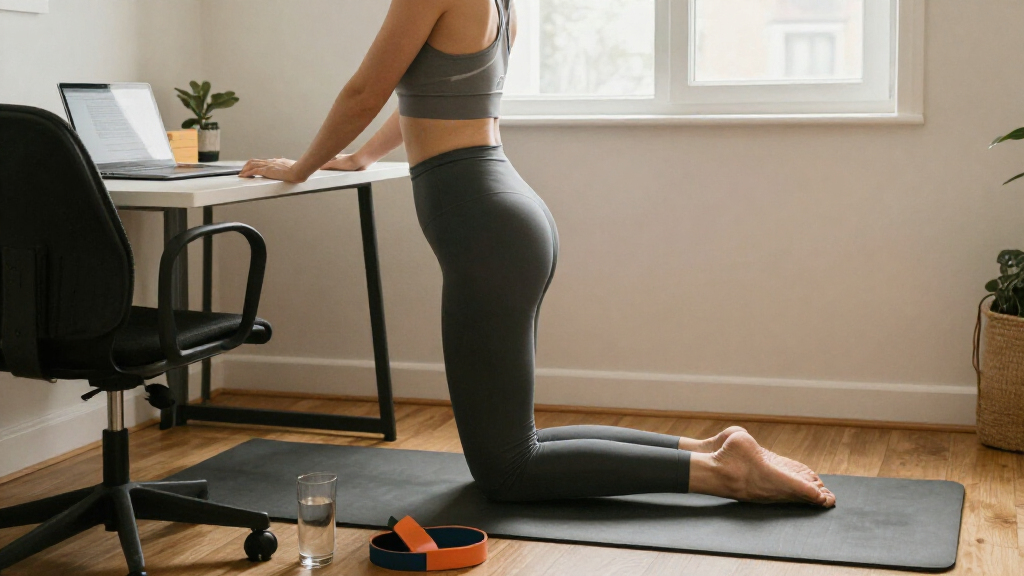
Certified personal trainer Liz Heikkila of Life Time Minnetonka, Minnesota, recommends strengthening the hip flexors, gluteus medius and posterior-chain muscles, including the glutes and hamstrings. The five movements she suggests are Pilates isometric abdominal work with pelvic tilts, glute bridges, a kneeling hip-flexor stretch, cobra holds and single-leg hip thrusts.
The report gives different prescriptions for each movement: two sets of five to 10 repetitions for the Pilates combination; two to three sets of 10 to 15 glute bridges; a 30-second hip-flexor stretch on each side; three 20-second cobra holds; and three sets of eight to 10 single-leg hip thrusts per side. Heikkila also advises reviewing sitting position and taking standing breaks, the report says.
Exercise Advice, Not a Proven Fix
The article offers a practical routine for readers who want to work on hip and glute strength and movement after prolonged sitting. It also makes an important distinction: a posture pattern does not necessarily mean a person has pain or needs treatment. The study cited in the report found pelvic tilt among many participants, yet all were described as asymptomatic.
That matters because readers should not treat the article’s personal account as evidence that desk work causes anterior pelvic tilt, or that a particular sequence will resolve it. The report describes an individual’s experience and a trainer’s exercise suggestions; it does not present a clinical trial testing the five-movement routine. People with pain, an injury or concerns about their posture may benefit from individualized advice from a qualified health professional rather than assuming a tilt is the source of symptoms.
Products Worth Considering

Garmin Venu 3S GPS Fitness Smartwatch, 41 mm, French Gray

Bowflex SelectTech 840 Adjustable Kettlebell

Withings Body Smart Wi-Fi and Bluetooth Body Composition Scale
As an affiliate, we earn on qualifying purchases.
The Report’s Posture Findings
Anterior pelvic tilt is described in the report as a posture pattern in which the pelvis rotates forward and downward while the lower back arches. Fit&Well cites a study titled “Assessment of the degree of pelvic tilt within a normal asymptomatic population,” published in the journal Manual Therapy. In a study group of 120 people, the report says, 85% of men and 75% of women had anterior pelvic tilt. It also says every participant was asymptomatic.
The writer connects the topic to desk work after their therapist suggested paying attention to sitting position and standing more often. Heikkila says people may sit with their feet tucked underneath them, which can encourage an exaggerated back arch or forward pelvic tilt. That is her explanation in the article, not proof that sitting causes the posture pattern in every person.
The report’s five exercises are presented as a daily routine. The movements include both strengthening and stretching, with the stated aim of addressing muscle imbalances and developing different movement habits. No outcome data are provided on whether the writer’s symptoms or pelvic alignment changed after starting the routine.
Cause and Results Remain Unknown
The report does not establish that the writer’s desk job caused anterior pelvic tilt. It says the therapist identified the posture pattern during treatment for IT band syndrome, but did not attribute that injury to the tilt. The cited study’s reported figures describe one group of 120 people; the source material does not provide enough information to determine how well those results apply to the wider population.
It is also unclear whether the exercise routine changed the writer’s pelvic alignment, improved any symptoms or affected the IT band condition. The article supplies no follow-up measurements or comparison group. It does not provide evidence that anterior pelvic tilt itself leads to pain in people without symptoms.
Monitor Comfort and Seek Guidance
The writer says they have incorporated Heikkila’s exercises into their routine, but the source material gives no later update on results. Readers following the routine should use controlled movements and stop if an exercise causes pain. Anyone with an existing injury, persistent discomfort or uncertainty about technique can seek guidance from a qualified clinician or exercise professional.
The next useful development would be a follow-up account with details on how the writer responded over time. The original report does not set out a formal evaluation or a timeline for measuring changes, so the impact of the exercises remains unreported.
Key Questions
What is anterior pelvic tilt?
The report describes anterior pelvic tilt as a posture pattern in which the pelvis rotates forward and downward while the lower back arches. It says a mild tilt does not necessarily cause symptoms.
Does desk work cause anterior pelvic tilt?
The Fit&Well report discusses sitting position as a possible factor, based on trainer Liz Heikkila’s comments. It does not establish that desk work causes the posture pattern.
Which five exercises does the report recommend?
The routine includes Pilates isometric abdominal work with pelvic tilts, glute bridges, a kneeling hip-flexor stretch, cobra holds and single-leg hip thrusts.
Does the cited study show that pelvic tilt causes pain?
No. The report says the study included 120 people and that all participants were asymptomatic. It does not show that pelvic tilt caused pain.
Have the exercises been shown to correct the writer’s pelvic tilt?
The source material provides no follow-up results or clinical testing of the routine. It describes the exercises as recommendations, not as a proven correction.
Source: fitandwell.com