TL;DR

Get wellness gear delivered free — and shop member deals
- Fast, free delivery on millions of items
- Access to Prime Big Deal Days deals on October 6–7
- Prime Video, Amazon Music and more included
Fit&Well published a personal trainer’s proposed 15-minute, dumbbell-based circuit that combines four exercises for the upper body, lower body and core. The routine is presented as a time-efficient option, not as a guarantee of results; its actual duration depends on pace, rest and fitness level.
Fit&Well has published a personal trainer’s four-exercise dumbbell circuit intended to work the upper body, lower body and core in a short workout. The trainer describes it as a 15-minute option for people with work or family commitments, while cautioning that beginners may need longer and should prioritize controlled form over speed.
The circuit pairs movements to involve several muscle groups at once: a squat to overhead press, a deadlift to row, a lateral lunge to curl, and a glute bridge to chest press. Fit&Well’s report says to perform 12 repetitions per exercise and repeat the circuit, listing three sets of 12 for each movement. The source does not specify how long to rest between exercises or rounds.
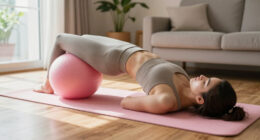
In the squat-to-press, the exerciser lowers into a squat with dumbbells at shoulder height, then stands and presses the weights overhead. The deadlift-to-row combines a hip hinge with a pull toward the hips. The lateral lunge-to-curl alternates sides, pairing a side step and lunge with a biceps curl. The final move is performed lying on the floor: lift the hips into a bridge while pressing dumbbells above the chest.
The report’s practical guidance is to move at a comfortable pace and rest as needed, particularly for people new to regular exercise. The trainer advises reducing the weight if posture falters, practicing the deadlift without weights to learn its movement, and returning the hips to the mat between bridge repetitions if needed. The stated 15 minutes is an estimate, not a guaranteed completion time.
A Short Circuit for Busy Schedules
The routine addresses a common scheduling barrier: the trainer says many clients have work and family commitments that make it hard to set aside exercise time. Combining lower-body movements with presses, rows and curls allows the session to cover several areas without requiring a long list of separate exercises. That makes it a practical format for readers who want a concise strength session, provided they have suitable dumbbells and room to move.
Its short format should not be mistaken for evidence that 15 minutes will produce a particular strength outcome. Fit&Well presents the workout as the trainer’s recommendation; the report does not provide trial results, comparisons with longer programs or measured outcomes. Readers can use the routine as a template, but the weights, pace and rest periods should reflect their own ability and experience.
adjustable dumbbells for full body workout
As an affiliate, we earn on qualifying purchases.
As an affiliate, we earn on qualifying purchases.
How the Four Moves Fit Together
The exercises cover several basic movement patterns: squatting, hinging at the hips, stepping laterally, pressing and rowing. Each combines two actions, such as a squat followed by an overhead press. This is why the trainer describes the circuit as a full-body routine, rather than a series aimed at one muscle group alone.
Fit&Well’s instructions call for three sets of 12 repetitions for each exercise, with the exercises performed in circuit fashion and the routine repeated. The exact time will depend on how quickly a person moves, how much rest they take, and whether they need to pause to maintain technique. The source specifically allows beginners to take longer than 15 minutes.
As an affiliate, we earn on qualifying purchases.
Timing and Individual Suitability
The report does not say how the 15-minute estimate was measured, how long participants should rest, or what dumbbell weights to use. It also provides no independent testing or evidence that the routine produces a particular amount of strength gain. The trainer’s recommendation is guidance, not a published evaluation of outcomes.
Whether every exercise is appropriate will depend on a person’s experience, mobility, health and available equipment. Fit&Well advises stopping if pain goes beyond muscle fatigue and checking with a doctor. Readers who are unsure about technique, have an existing injury or have a health condition should seek qualified professional guidance before attempting the routine.
dumbbell workout guide for beginners
As an affiliate, we earn on qualifying purchases.
As an affiliate, we earn on qualifying purchases.
Adjust the Workout to Your Pace
There is no further milestone or follow-up announced in the source report. For someone trying the circuit, the next step is to select manageable weights, learn each movement and allow enough rest to keep good form. The trainer suggests shortening rest periods or moving more quickly only as strength and endurance develop, and not at the expense of technique.
Anyone who cannot complete the sequence within 15 minutes can take longer; the source explicitly says that is acceptable. Stop if sharp or unusual pain occurs, and seek medical advice when appropriate. The article does not establish a recommended weekly frequency for this specific circuit.
full body dumbbell exercise equipment
As an affiliate, we earn on qualifying purchases.
As an affiliate, we earn on qualifying purchases.
Key Questions
What exercises are in the 15-minute circuit?
It includes a dumbbell squat to press, deadlift to row, lateral lunge to curl, and glute bridge to chest press.
How many repetitions does the trainer recommend?
Fit&Well lists three sets of 12 repetitions for each exercise, performed in circuit style. The source does not give a specific rest interval.
Does the workout have to be completed in 15 minutes?
No. The trainer says beginners may take longer and recommends moving at a comfortable pace and resting as needed. The 15 minutes is a target, not a requirement.
What should someone do if an exercise causes pain?
The report says to stop if pain goes beyond muscle fatigue and check with a doctor. It also advises against sacrificing form for speed; anyone uncertain about suitability can seek guidance from a qualified professional.
Source: rss
Fall Picks
fall essentials
As an affiliate, we earn on qualifying purchases.