TL;DR

Get wellness gear delivered free with Prime
- Fast, free delivery on millions of items
- Prime Video, Amazon Music and more included
- Member-only deals all year
Fit&Well reports that Tai Chi teacher Brian Thompson recommends a five-minute evening sequence of breathing, gentle movement and self-massage to help people unwind. The report describes the routine but does not provide evidence that it treats insomnia or improves sleep outcomes.
Fit&Well has published a five-minute evening Tai Chi routine from teacher Brian Thompson for people looking to unwind before bed. The sequence combines paced breathing, gentle arm and waist movements, and self-massage; its proposed relaxation and sleep effects are Thompson’s guidance, not results from a clinical study cited in the report.
The routine begins with one to two minutes of seated breathing. Practitioners sit upright on a sturdy chair with feet flat on the floor, breathe naturally through the nose and relax the stomach, shoulders and chest. The instructions suggest imagining the breath rising and falling like a waterfall.
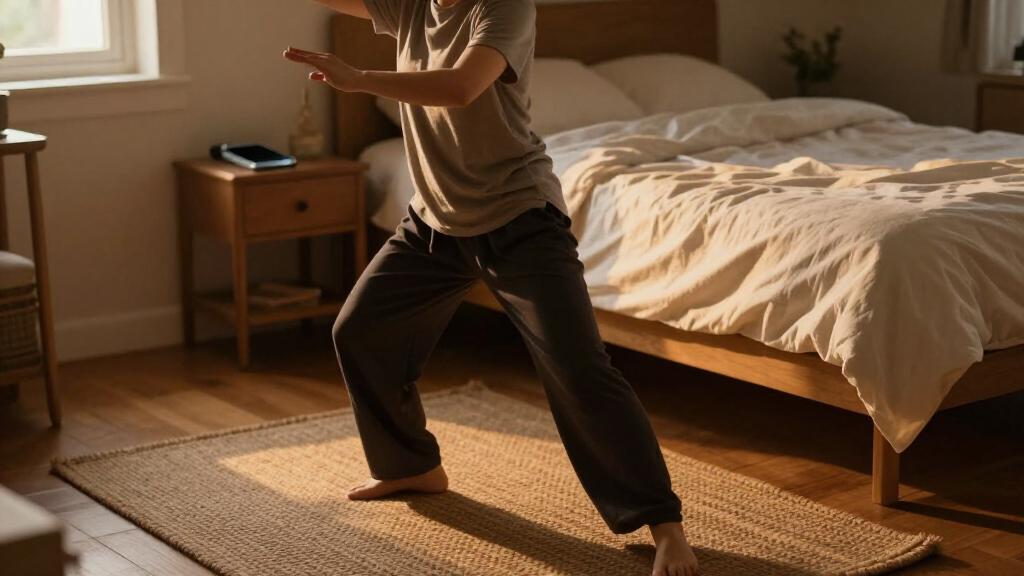
Next, the sequence calls for two or three repetitions of “Lift Water”: standing with feet about shoulder-width apart, raising relaxed arms to shoulder height while inhaling, then lowering them. The longer silk-reeling section adds slow waist turns and shifts of body weight from one leg to the other. The guide asks practitioners to coordinate movement with breathing and to try each side before combining both hands.
To finish, participants sit or stand beside the bed and massage and gently pat areas of the body, including the neck, shoulders, arms, torso and legs. The source does not specify that the routine must be completed exactly as written or provide clinical measurements of its effects.
A Short Routine, Not a Sleep Treatment
A five-minute sequence may appeal to people seeking a brief, low-impact wind-down activity that does not require equipment. The steps are laid out in a specific order, making the suggestion practical to try at home for someone who can move comfortably while standing or sitting.
But the distinction between relaxation advice and evidence of a sleep benefit matters. Fit&Well’s report presents Thompson’s explanation of how the practice may help someone settle before bed; it does not report a trial, measured sleep outcomes, or evidence that Tai Chi can treat persistent insomnia. Readers should not take the recommendation as a substitute for medical advice about ongoing sleep problems.
As an affiliate, we earn on qualifying purchases.
How the Evening Practice Is Structured
The source describes Tai Chi as an ancient Chinese practice centered on gentle movement and breathing, and says it can be practiced at different times of day. This particular routine is framed for evening use and progresses from seated breathing to standing movements and then touch-based self-massage.
Thompson, identified by Fit&Well as a Tai Chi teacher and founder of BNEW4LIFE, says the practice is intended to address tension accumulated during the day. His comments explain the rationale for the routine, but the article does not give details about his assessment method or cite independent research supporting each claimed effect.
“The benefit of an evening Tai Chi practice is that it helps to unwind accumulated physical tension in the back, neck and shoulders from the day.”
— Brian Thompson, Tai Chi teacher and founder of BNEW4LIFE, as quoted by Fit&Well
As an affiliate, we earn on qualifying purchases.
Sleep Effects Are Not Measured
The report does not establish whether this routine improves sleep, how often it should be practiced, or which people are most likely to benefit. It also gives no comparison with other wind-down routines and no data on how long any relaxation effect might last.
The article does not describe safety testing or modifications for people with balance, mobility or joint concerns. The movements are presented as gentle, but readers should stop if they feel pain, dizziness or unsteadiness, and adapt or skip standing steps if needed. Whether the sequence has an effect beyond providing a calm pre-bed activity remains unclear from the source.
As an affiliate, we earn on qualifying purchases.
Trying the Steps at Home
Readers can follow the sequence as a short relaxation practice, beginning seated and moving to standing only if comfortable. The instructions recommend slow movements and coordinating them with the breath; they do not set out a required schedule or promise a particular result.
Fit&Well’s report offers no announced follow-up study or evaluation. Anyone whose sleep difficulty is persistent or affecting daily life may want to discuss it with a healthcare professional rather than relying on a brief routine alone.
gentle movement routines for sleep
As an affiliate, we earn on qualifying purchases.
As an affiliate, we earn on qualifying purchases.
Key Questions
What does the five-minute Tai Chi routine include?
It includes seated breathing, gentle arm raises, waist turns and weight shifts known as silk reeling, followed by massage and gentle cupping or patting of the body.
Who recommends the practice?
Brian Thompson, identified by Fit&Well as a Tai Chi teacher and founder of BNEW4LIFE, recommends the evening sequence.
Does the report prove Tai Chi helps insomnia?
No. The report gives Thompson’s rationale for using the routine to unwind but does not cite a clinical study or report measured sleep outcomes. It does not establish the routine as an insomnia treatment.
Can the routine be adapted for comfort?
The sequence starts seated and then includes standing movements. People who feel unsteady or uncomfortable can remain seated, skip movements that cause pain, or seek professional guidance about suitable activity.
Source: rss
Cold & flu season Picks
humidifiers
As an affiliate, we earn on qualifying purchases.