
TL;DR

Get wellness gear delivered free with Prime
- Fast, free delivery on millions of items
- Prime Video, Amazon Music and more included
- Member-only deals all year
Fit&Well published a six-exercise warm-up used by NASM-certified trainer Kelsey Sherwin before weight training. The sequence combines mobility and activation movements, but the report does not provide evidence that this particular routine improves lifting performance or prevents injuries.
Fit&Well has reported on a six-exercise warm-up that NASM-certified trainer Kelsey Sherwin says she performs before lifting weights. The routine moves from marching and mobility work to planks, dumbbell presses, hip hinges and banded side steps; it is her recommended preparation, not a study showing the sequence prevents injuries or improves strength.
Sherwin, a strength-training specialist with Raeya Wellness in Los Angeles, said her routine is intended to activate muscles used in the workout and help her focus before training. She recommends adapting a warm-up to the planned activity rather than assuming one sequence suits every workout. The Fit&Well report presents this sequence specifically as a pre-weight-training option.
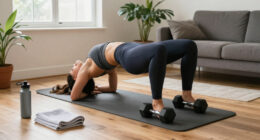
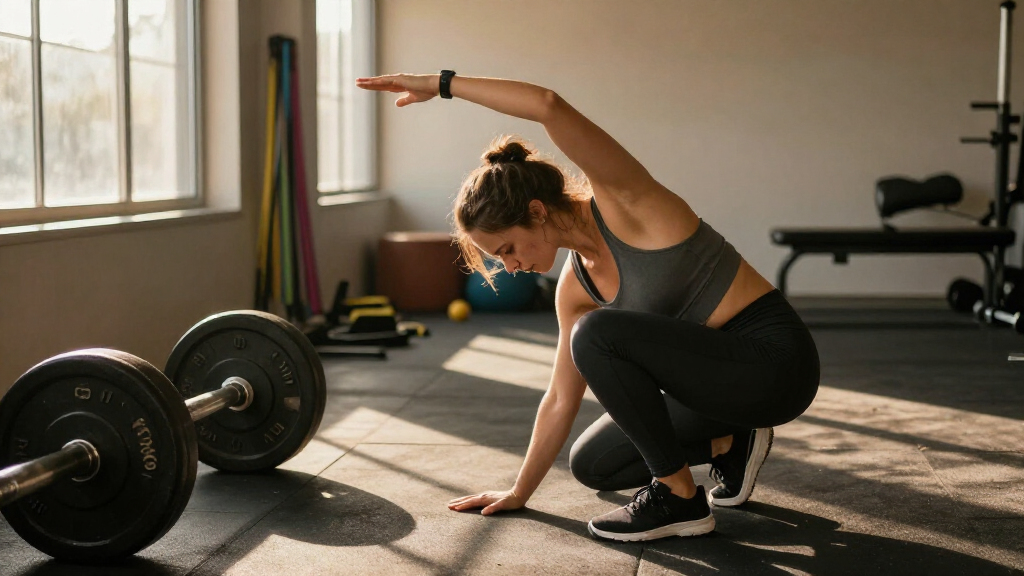
The six movements are a one-minute march and reach, followed by the world’s greatest stretch for 30 seconds per side and 20 plank shoulder taps on each side. The remaining exercises are 10 to 15 squat-to-press repetitions with dumbbells, 10 to 15 hip hinges, and 10 banded side steps in each direction.
The sequence combines several kinds of movement: the marching raises activity gradually, the stretch includes a lunge and torso rotation, and the plank taps challenge the ability to hold a steady position. The squat-to-press adds light resistance, while hip hinges and banded steps rehearse movements involving the hips and legs. The article does not specify a required load for the dumbbells or resistance level for the band.
A Routine to Prepare for Lifting
The report offers readers a specific sequence they can review before a weights session, rather than simply advising them to warm up. Its mix of movements may help someone rehearse actions they will use during training and bring attention to posture, balance and range of motion before picking up heavier weights.
Sherwin also describes warming up as a way to prepare mentally. That is her stated experience, not a measured outcome in the report. The article cites her view that warming up can support blood flow and joint mobility and may enhance performance or reduce injury risk, but it does not present trial data about this six-move routine or establish that it produces those results for every person.
For readers, the distinction matters: the routine is a trainer’s practical recommendation, not a personalized program or a guarantee. People can adjust movements to their mobility and fitness level, use manageable resistance, and stop if an exercise causes pain. Those returning after an injury or managing a health condition may wish to ask a qualified professional for guidance before changing their training.
Products Worth Considering

BowFlex Results Series SelectTech Adjustable Dumbbells (Pair)

TheraGun Therabody PRO Plus 6-in-1 Deep Tissue Massage Gun, Black

Garmin Forerunner 165 GPS Running Smartwatch, 43 mm, Black
As an affiliate, we earn on qualifying purchases.
Why Warm-Ups Vary by Workout
The Fit&Well report contrasts Sherwin’s approach with brief school-style warm-ups, such as jumping jacks and arm swings, which its writer says had shaped their earlier view of warming up. The writer says they changed that view after learning a more structured approach. That account is personal experience; it is not a study comparing warm-up methods.
Sherwin says the movements in a warm-up should reflect the activity ahead. A walking session and an arm-focused workout place different demands on the body, so a single routine may not be the best fit for both. Her six-move sequence is offered as a weight-training warm-up, with a combination of whole-body movement and exercises using light equipment.
The report also gives modifications within the instructions: during the world’s greatest stretch, the forward foot can land outside the hand or as close as the person’s mobility allows. That makes clear the exercise can be adjusted, though the article does not provide individualized alternatives for every movement.
““Warming up before exercise or lifting helps increase blood flow to your muscles, improve joint mobility, and prepare your body for movement, which can enhance performance and reduce the risk of injury.””
— Kelsey Sherwin, as quoted by Fit&Well
Evidence and Individual Fit
The source material does not give a publication date, identify a study testing Sherwin’s routine, or report measured changes in lifting performance or injury rates. It is therefore unclear whether this exact sequence produces the benefits described, and the report should not be read as proof that it prevents injury.
The instructions also leave some practical details open. They do not name a dumbbell weight, resistance-band strength, or rest periods, and they do not say how the routine should change for a particular lift, training history or physical limitation. The report does not establish that every reader should perform all six exercises in the listed amounts.
How to Use the Routine
The report does not announce a follow-up study, product launch or other next milestone. Its practical suggestion is for readers to try the six movements before a weight-training session and observe how they feel, while recognizing that any perceived difference is personal experience rather than proof of a general effect.
Anyone trying the sequence can keep the effort controlled, choose manageable resistance and adjust the range of motion to their abilities. If movements cause pain, they should stop; people with an injury, a pre-existing condition or questions about safe exercise choices can seek advice from a qualified health or fitness professional. No further testing or update is specified in the source report.
Key Questions
What warm-up did Kelsey Sherwin share?
She shared six movements for before weight training: march and reach, the world’s greatest stretch, plank shoulder taps, squat to press, hip hinge and banded side step.
How many repetitions or how much time does the routine call for?
The report lists a one-minute march and reach, 30 seconds per side for the stretch, 20 shoulder taps per side, 10 to 15 squat-to-press repetitions, 10 to 15 hip hinges, and 10 banded steps in each direction.
Does the report prove this warm-up prevents injuries?
No. Sherwin says warming up can prepare the body and may reduce injury risk, but the source provides no study or measured injury data for her particular six-exercise routine.
Can the routine be used before any workout?
Sherwin says warm-ups should reflect the activity planned. The sequence is presented for weight training, not as a universal routine for every form of exercise.
Source: fitandwell.com