
Buyers searching for water filter pitchers with remineralization will find that these four picks are not simple gravity pitchers: each pairs reverse osmosis filtration with a mineral stage and a pitcher or dispensing setup. My best overall pick is the Slevoo C2-M25 for its size options, TDS display, and glass pitcher. The SimPure Y7T-A is a strong fit for buyers who want a straightforward countertop unit, while the iSpring RCC7AK-BN is the option to consider when certified under-sink filtration matters more than portability.

Get wellness gear delivered free with Prime
- Fast, free delivery on millions of items
- Prime Video, Amazon Music and more included
- Member-only deals all year
The key tradeoff is convenience versus installation and capacity. Countertop units avoid plumbing work, but need counter space, power, and source water within their stated TDS limits. The iSpring takes more setup and cabinet room, yet carries NSF/ANSI 58 certification as a complete system. Mineral stages also differ: they add minerals after reverse osmosis, but claims about pH or mineral content are not interchangeable. I ranked the options by how well their design, stated features, and practical limits serve buyers who specifically want remineralized water.
Key Takeaways
- The Slevoo C2-M25 is my most balanced countertop pick: it combines a glass pitcher, three dispensing sizes, TDS monitoring, and filter-life tracking.
- The SimPure Y7T-A suits buyers who want a simpler countertop setup and a 528-gallon cartridge rating, but its lid needs up to 21.3 inches of clearance when open.
- The iSpring RCC7AK-BN is the only under-sink option here with stated NSF/ANSI 58 certification for the complete system; it requires cabinet space and periodic filter changes.
- The Slevoo 5L model automates filling a 40-ounce glass pitcher, while its claimed two-year filter interval and 500 ppm source-water ceiling deserve attention.
- All four use reverse osmosis before remineralization, so buyers should check source-water TDS limits, replacement schedules, and whether a countertop or installed system fits their home.
| Slevoo Countertop Reverse Osmosis Water Filter with Remineralization | 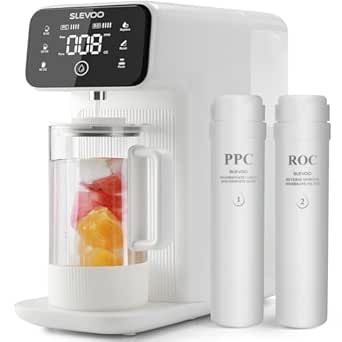 | Best Overall | Filtration: Six-stage reverse osmosis | Remineralization: Calcium, magnesium, sodium, and potassium | Pitcher / capacity: Glass pitcher; 4-liter tank | VIEW ON AMAZON | See Our Full Breakdown |
| SimPure Y7T-A Countertop 5-Stage Reverse Osmosis Water Filter with Mineral-Enhancing Glass Pitcher |  | Best for a Straightforward Countertop Setup | Filtration: Five-stage reverse osmosis | Mineral stage: Adds calcium, magnesium, and potassium | Pitcher material: Borosilicate glass | VIEW ON AMAZON | See Our Full Breakdown |
| Slevoo Countertop Reverse Osmosis Water Filter with Alkaline Remineralization |  | Best for Automatic Pitcher Filling | Filtration: Six-stage reverse osmosis; 0.0001 μm membrane | Pitcher: 40 oz, food-grade glass | Water tank: 5 L | VIEW ON AMAZON | See Our Full Breakdown |
| iSpring RCC7AK-BN NSF-Certified 6-Stage Alkaline Reverse Osmosis Water Filter System |  | Best Certified Under-Sink Option | Filtration: Six-stage reverse osmosis with alkaline stage | Certification: NSF/ANSI 58 | Installation: Under sink | VIEW ON AMAZON | See Our Full Breakdown |
| water filter pitchers with remineralization | Filtration | Source-water TDS limit | Pure-to-drain ratio | Installation |
|---|---|---|---|---|
| Slevoo Countertop Reverse Osmo | Six-stage reverse osmosis | 500 ppm maximum | 4:1 | — |
| SimPure Y7T-A Countertop 5-Sta | Five-stage reverse osmosis | — | 4:1 | — |
| Slevoo Countertop Reverse Osmo | Six-stage reverse osmosis; 0.0001 μm membrane | 500 ppm maximum | — | Countertop; no installation required |
| iSpring RCC7AK-BN NSF-Certifie | Six-stage reverse osmosis with alkaline stage | — | — | Under sink |
More Details on Our Top Picks
Slevoo Countertop Reverse Osmosis Water Filter with Remineralization
The C2-M25 takes the most balanced approach to the pitcher part of this roundup. Its glass pitcher, 4-liter tank, and three dispensing sizes make it easier to serve a single glass or fill a larger vessel without pouring from a fixed faucet. A real-time TDS display and filter-life indicator add useful status information for a countertop system; they help track readings and maintenance, though a TDS display cannot identify every contaminant or certify water safety.
Compared with the SimPure Y7T-A, this model offers more dispensing choices and more on-unit monitoring, while the SimPure has a stated 528-gallon cartridge rating and a simpler feature set. The C2-M25 also lists six-stage filtration and remineralization with calcium, magnesium, sodium, and potassium. Its 4:1 pure-to-drain ratio matches the other countertop systems here, so that figure does not make it a standout on water use. The listed 500 ppm maximum source-water TDS is another shared boundary with the Slevoo 5L model.
I place it first because it combines the most decision-useful features without requiring installation. The tradeoff is that it still needs counter space, an electrical outlet, and routine cartridge replacement; the stated 12–24 month filter life is a range, not a guarantee for every household. Buyers who want automatic filling should compare it with the larger Slevoo 5L unit, while anyone prioritizing third-party system certification should look at the iSpring instead.
Pros:- Glass pitcher and remineralization are included.
- Three dispensing sizes serve different glass and vessel needs.
- TDS display and filter-life indicator provide operating information.
- Four-liter capacity and a stated 4:1 pure-to-drain ratio.
Cons:- Source-water TDS must be no higher than 500 ppm.
- Requires counter space, electricity, and replacement cartridges.
- A TDS reading does not identify specific contaminants.
Best for: Households wanting a countertop RO system with a glass pitcher, several serving sizes, and visible TDS and filter-life information.
Not ideal for: Buyers who need stated NSF/ANSI 58 certification, cannot spare counter space or an outlet, or have source water above 500 ppm TDS.
- Filtration:Six-stage reverse osmosis
- Remineralization:Calcium, magnesium, sodium, and potassium
- Pitcher / capacity:Glass pitcher; 4-liter tank
- Dispensing:8 oz, 20 oz, and 40 oz
- Source-water TDS limit:500 ppm maximum
- Pure-to-drain ratio:4:1
- Filter life:12–24 months, as listed
- Installation / power:Countertop; corded electric
Our verdict“I rank the C2-M25 first for its useful balance of glass-pitcher convenience, flexible dispensing, and monitoring, with the caveat that its display is not a substitute for contaminant testing.”
SimPure Y7T-A Countertop 5-Stage Reverse Osmosis Water Filter with Mineral-Enhancing Glass Pitcher
The SimPure Y7T-A is a good match for buyers who want countertop reverse osmosis without plumbing and do not need multiple dispense sizes or an automated fill cycle. Its borosilicate glass pitcher is paired with an alkaline filter that adds calcium, magnesium, and potassium. Quick-change cartridges are rated for 528 gallons, giving buyers a clear capacity figure to compare with household use and the manufacturer’s replacement guidance.
Compared with the Slevoo C2-M25, the SimPure is less feature-rich: the supplied details do not list a TDS display, filter-life indicator, or three serving presets. Its appeal is the more direct pitcher-centered arrangement and a defined cartridge rating. It also shares the 4:1 pure-to-drain ratio listed for the Slevoo countertop models. Like those units, it has a 500 ppm source-water TDS limit, so buyers with higher-TDS feed water need another option or manufacturer guidance.
Check the height before choosing a spot. The unit measures 16.1 inches with the lid closed and needs up to 21.3 inches with the lid open, which can rule out a low cabinet clearance. It dispenses room-temperature water only, so it will not replace a chilled pitcher. I rank it just behind the C2-M25 because it covers the core remineralizing-countertop use well but offers fewer controls and serving conveniences.
Pros:- No plumbing installation is required.
- Borosilicate glass pitcher pairs with an alkaline mineral stage.
- Quick-change cartridges are rated for 528 gallons.
- Stated 4:1 pure-to-drain ratio.
Cons:- Dispenses room-temperature water only.
- Open-lid height reaches 21.3 inches.
- Designed for source water below 500 ppm TDS.
Best for: People who want a no-install countertop RO unit with a borosilicate glass pitcher and a stated cartridge capacity.
Not ideal for: Buyers who need chilled water, low-clearance placement, on-unit TDS monitoring, or source-water support above 500 ppm TDS.
- Filtration:Five-stage reverse osmosis
- Mineral stage:Adds calcium, magnesium, and potassium
- Pitcher material:Borosilicate glass
- Pure-to-drain ratio:4:1
- Height:16.1 in closed; 21.3 in open
- Water temperature:Room temperature only
- Power / installation:Plug-in; no installation required
Our verdict“I recommend the Y7T-A to buyers who value a simple glass-pitcher countertop setup over the extra monitoring and serving presets of the C2-M25.”
Slevoo Countertop Reverse Osmosis Water Filter with Alkaline Remineralization
This Slevoo model centers its design on a 5-liter tank and automatic 40-ounce pitcher fill. That setup suits people who want to set a glass pitcher in place and collect a ready-to-serve batch, rather than selecting among several serving sizes as on the C2-M25. It also has a food-grade glass pitcher, six-stage reverse osmosis, alkaline remineralization, and a display for raw and purified water TDS and filter life.
Compared with the SimPure Y7T-A, the 5L Slevoo adds automatic filling and more monitoring information, but it asks buyers to make sense of more performance claims. The listing states a maximum contaminant-removal claim, a remineralized pH of at least 7.5, and a filter replacement interval of once every two years. Those are manufacturer claims and should be checked against the current product documentation; pH and TDS readings alone do not show whether particular contaminants meet a health standard. Its 500 ppm source-water limit matches the C2-M25 and SimPure.
The two-year replacement interval may appeal to buyers seeking less frequent maintenance, but actual service needs can depend on water and use. The product information also gives a daily replacement-cost figure, so buyers should factor ongoing cartridge expense into ownership without treating the interval as universal. I rank it behind the first two because the automatic fill is a meaningful convenience, but the C2-M25 offers more serving sizes and the SimPure gives a simpler capacity-based cartridge comparison.
Pros:- Automatic filling stops at the 40-ounce pitcher capacity.
- Includes a glass pitcher with alkaline remineralization.
- Display tracks filter life and raw and purified water TDS.
- Five-liter tank and stated 4:1 filtered-water-to-waste ratio.
Cons:- Source water is limited to 500 ppm TDS maximum.
- The two-year filter interval is a stated claim, not a universal service guarantee.
- Automatic pitcher filling offers less portion flexibility than the C2-M25 presets.
Best for: Households that want a countertop RO unit to fill a 40-ounce glass pitcher automatically, with TDS and filter-life displays.
Not ideal for: Buyers with source water above 500 ppm TDS, those who want several serving presets, or anyone relying on pH or TDS displays as a full contaminant test.
- Filtration:Six-stage reverse osmosis; 0.0001 μm membrane
- Pitcher:40 oz, food-grade glass
- Water tank:5 L
- Remineralized pH:≥7.5, as claimed
- Source-water TDS limit:500 ppm maximum
- Filtered-water-to-waste ratio:4:1
- Filter interval:Once every 2 years, as claimed
- Installation:Countertop; no installation required
Our verdict“I favor this Slevoo for buyers who value batch convenience more than serving-size control, while its replacement claims and source-water limit merit a close check.”
iSpring RCC7AK-BN NSF-Certified 6-Stage Alkaline Reverse Osmosis Water Filter System
The iSpring RCC7AK-BN differs from the other picks at the most basic level: it is an under-sink system, not a countertop pitcher unit. Its strongest reason to make this list is NSF/ANSI 58 certification for the complete system, alongside a six-stage process that includes reverse osmosis and a mineral stage. For a buyer whose priority is documented system certification and a fixed kitchen faucet, that distinction carries more weight than countertop portability.
Compared with the three plug-in countertop systems, the iSpring needs cabinet space and an installation, but it does not require electrical power. The manufacturer lists a maximum supported TDS of 750 ppm, higher than the 500 ppm limit specified for the countertop choices. It also lists reductions for a range of contaminants, including lead, PFAS, chlorine, and TDS. Buyers should consult the certification details and current documentation for the specific substances and conditions covered, rather than assuming every claim applies to every water supply.
Its downsides are practical: the system measures 15.5 × 16 × 18 inches, and the listed filter cycle starts at six months, so maintenance is more frequent than the two-year interval claimed for the 5L Slevoo. The listing gives a 75-gallon capacity and maximum flow rate of 284 liters per day; this is a plumbed system rather than a portable pitcher you can move around. I rank it fourth only because this roundup prioritizes pitcher-style convenience. For buyers who put certification and under-sink integration first, it may be the most appropriate choice.
Pros:- NSF/ANSI 58 certification is listed for the complete system.
- Six-stage filtration includes reverse osmosis and an alkaline mineral stage.
- Maximum supported source-water TDS is listed at 750 ppm.
- No power is needed; quick-fitting connections and a top-mounted fastener aid installation.
Cons:- Requires under-sink space and installation.
- Listed filter cycle starts at six months, requiring regular upkeep.
- It is not a countertop pitcher system and is less portable than the other picks.
Best for: Homeowners who can install an under-sink system and prioritize stated NSF/ANSI 58 certification over a portable glass-pitcher setup.
Not ideal for: Renters avoiding plumbing work, homes without cabinet space, or buyers who specifically need a removable pitcher and countertop installation.
- Filtration:Six-stage reverse osmosis with alkaline stage
- Certification:NSF/ANSI 58
- Installation:Under sink
- Maximum supported TDS:750 ppm
- Maximum flow rate:284 liters per day
- Operating pressure:70 psi
- Filter cycle:Six months, as listed
- Dimensions:15.5 × 16 × 18 in
- Power:No power needed
Our verdict“I recommend the iSpring when under-sink integration and stated system certification matter more than the portable pitcher format that defines the other three picks.”

How We Picked
I ranked these products for buyers who want reverse osmosis plus remineralization, rather than treating them as interchangeable water pitchers. I compared their installation demands, pitcher materials, water capacity and dispensing, stated source-water limits, filter schedules, monitoring features, and the specific mineral-stage details provided. I gave weight to practical fit: a glass pitcher may suit someone avoiding plastic contact, while automatic filling or multiple serving sizes can matter more to a busy household.
I also separated claims that are easy to blur together. The iSpring lists NSF/ANSI 58 certification for the complete system; the countertop products describe filtration and contaminant claims, but the supplied product information does not state that same certification. I do not treat a TDS reading as proof that every contaminant is absent, or an alkaline pH claim as a health benefit. Where a model lists a maximum source-water TDS or a replacement interval, I treat that as a boundary buyers should verify against their own water and the manufacturer’s instructions.
My order favors the most balanced fit first, followed by options with a clearer specialty: low-fuss countertop operation, automated pitcher filling, and certified under-sink performance. That ranking is not a claim that one system removes every contaminant in every home. Buyers should match the unit’s documentation to a water test and their own requirements.
| water filter pitchers with remineralization | Filtration | Installation |
|---|---|---|
| Slevoo Countertop Reverse Osmo | Six-stage reverse osmosis | — |
| SimPure Y7T-A Countertop 5-Sta | Five-stage reverse osmosis | — |
| Slevoo Countertop Reverse Osmo | Six-stage reverse osmosis; 0.0001 μm membrane | Countertop; no installation required |
| iSpring RCC7AK-BN NSF-Certifie | Six-stage reverse osmosis with alkaline stage | Under sink |
Factors to Consider When Choosing Water Filter Pitchers With Remineralization
A remineralizing RO pitcher setup is a combination of filtration, post-filter mineral addition, and a way to collect or dispense the water. I would choose based on the water entering the unit and how I want to use the finished water.Check the source-water limit before comparing features
The three countertop models in this roundup list a 500 ppm maximum source-water TDS; the iSpring lists up to 750 ppm. Compare that limit with a reliable test of your feed water and the current manufacturer instructions. TDS is a measure of dissolved material, not a specific contaminant report. A lower reading does not prove that water is free of lead, PFAS, or other substances, and a higher reading does not tell you which substances are present. For targeted concerns, use a water test and check the system’s documentation for the relevant reduction claims or certification.
Understand what remineralization does
Reverse osmosis removes many dissolved substances; a mineral stage adds selected minerals back after filtration. The SimPure lists calcium, magnesium, and potassium, while the C2-M25 adds those plus sodium. The other Slevoo model describes alkaline remineralization and a pH claim. These descriptions are not identical, and added minerals or higher pH should not be read as a medical benefit. If mineral content, taste, or pH matters to you, check the current product specifications and decide which stated mineral profile suits your preference.
Choose between a pitcher routine and a fixed faucet
The countertop units require a place on the counter and a power outlet, but avoid plumbing work and keep the glass pitcher easy to access. The SimPure needs up to 21.3 inches of clearance with its lid open. The C2-M25 offers three dispense sizes; the 5L Slevoo automatically fills a 40-ounce pitcher. The iSpring instead uses under-sink space and installation, but does not need power. I would measure both counter clearance and cabinet capacity before choosing, especially in a small kitchen or rental.
Compare pitcher capacity and everyday use
A larger tank or automatic pitcher fill can cut down on repeated handling, while preset portions may suit single servings. The Slevoo 5L model is designed around its 40-ounce glass pitcher, and the C2-M25 lists a 4-liter capacity with 8-, 20-, and 40-ounce selections. SimPure’s product details emphasize its glass pitcher and cartridge capacity rather than a list of serving sizes. The iSpring’s listed 75-gallon capacity belongs to an installed system, not a removable pitcher. Match the format to how often you fill bottles, serve a household, or store water in the refrigerator.
Treat maintenance claims as part of the fit
Replacement intervals vary: SimPure gives a 528-gallon cartridge rating, the C2-M25 lists 12–24 months, the 5L Slevoo claims a two-year interval, and iSpring lists a six-month filter cycle. These figures may depend on feed-water quality and use, so follow the exact replacement guidance for each cartridge. Check that replacements are available and budget for ongoing upkeep before buying. A display can remind you about filter life, but it does not replace scheduled service or prove that a cartridge is performing as intended.
Read certification and contaminant claims precisely
The iSpring is the only model here with NSF/ANSI 58 certification stated for the complete system. The countertop units list filtration stages and contaminant-reduction claims, but the supplied specifications do not give the same certification. Look up the current certification listing and the substances it covers if third-party verification is a deciding factor. Do not treat a general percentage-removal statement, TDS display, or alkaline pH reading as proof of removal for a particular contaminant.
Frequently Asked Questions
Are these all traditional water filter pitchers?
No. The SimPure and both Slevoo picks are countertop reverse osmosis systems that collect or dispense water through a pitcher-style setup. The iSpring is an under-sink system with a faucet, not a removable pitcher. I included it because it combines reverse osmosis with an alkaline mineral stage, but it suits a different installation preference than the countertop options.
Does remineralization mean the filtered water is alkaline?
Not necessarily in a way that can be assumed across products. The mineral stages and stated mineral additions differ, and only one listing here gives a specific pH claim. Added minerals can change water composition and taste, but a pH claim is not evidence of a health benefit. Check the product’s current documentation if mineral content or pH is a deciding factor.
Can I use a TDS display to confirm that water is safe?
No. A TDS display reports a total dissolved-solids reading, not a list of the substances in the water. It cannot confirm that a specific contaminant such as lead or PFAS is absent. I would use it as an operating indicator and rely on relevant certification details, product documentation, and water testing for contaminant-specific questions.
Which model is easiest to set up without plumbing?
The countertop choices are designed to avoid under-sink installation. The SimPure and both Slevoo models still need counter space and electrical power, so check outlet access and dimensions before ordering. The iSpring is the exception: it is a non-powered under-sink system, but it requires cabinet space and plumbing installation.
How should I compare the filter replacement intervals?
Use each model’s stated schedule as a starting point, then follow the current instructions for the specific cartridge and your water conditions. SimPure lists a 528-gallon cartridge rating, the C2-M25 lists 12–24 months, the 5L Slevoo claims once every two years, and the iSpring lists a six-month cycle. These are not directly equivalent measurements; check cartridge availability, maintenance requirements, and any usage or water-quality limits.
Conclusion
For most buyers who want a countertop system with a glass pitcher and useful controls, I recommend the Slevoo C2-M25; it offers several serving sizes and monitoring, though its 500 ppm source-water ceiling still applies. Choose the SimPure Y7T-A if you prefer a simpler countertop routine and a 528-gallon cartridge rating, provided you have room to open its lid and do not need chilled dispensing. The Slevoo 5L model makes more sense for households that want automatic 40-ounce pitcher filling. If your priority is a certified system under the sink rather than portability, consider the iSpring RCC7AK-BN and plan for installation, cabinet space, and regular filter changes. In every case, I would match the stated limits and certification details to a test of the water you actually plan to filter.