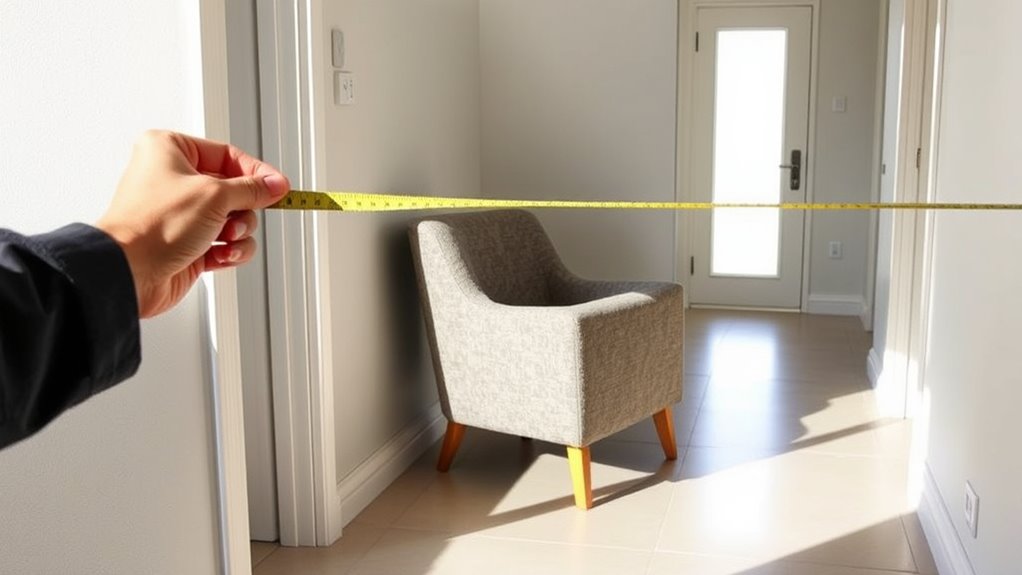

To determine if your new chair will fit, measure your doorway’s width, height, and any trim or hardware that could block entry. Compare these figures to your chair’s dimensions, adding at least 1-2 inches for clearance. Also, measure your hallway or room to ensure the chair can turn and move comfortably without damage. Keep in mind these steps help avoid surprises later—continue to explore how to facilitate your space planning.
Key Takeaways
- Measure the doorway’s narrowest width and height, including trim and hardware, to ensure accurate fitting.
- Compare the chair’s dimensions with doorway measurements, leaving at least 1-2 inches for smooth passage.
- Check clearance in hallways, stairwells, and tight spaces to prevent maneuvering issues during placement.
- Measure intended room and path to confirm the chair will fit without obstructing doors or furniture.
- Use precise measurements to plan space effectively, avoiding the purchase of a chair that cannot be moved inside.
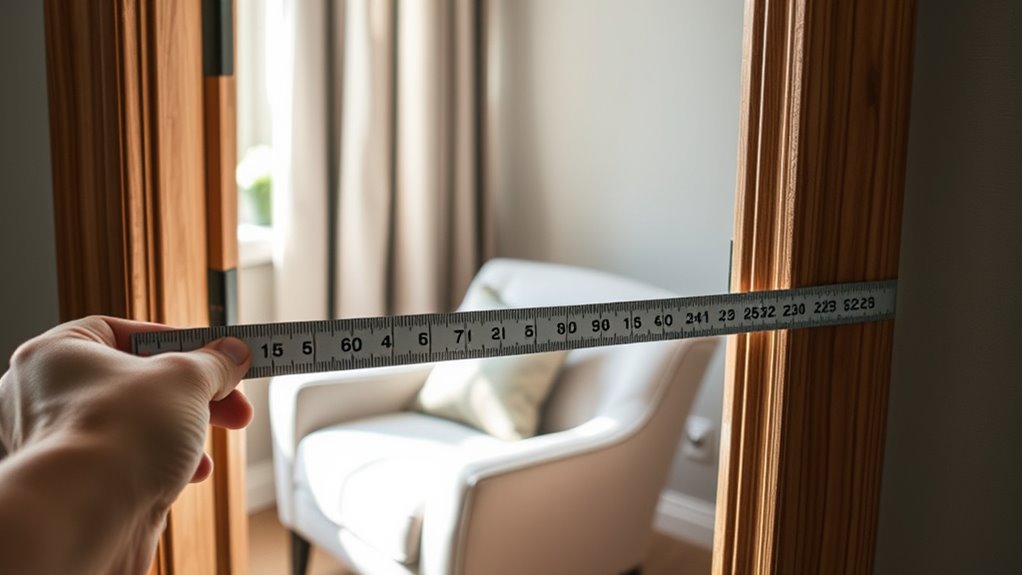
When you’re choosing a new chair, guaranteeing it will fit through your doorways and into your space is essential. The first step in this process is understanding your doorway dimensions. Measure the width and height of your doorframes accurately, including any trim or molding that might interfere with the chair’s passage. Keep in mind that doorways often have varying measurements, so don’t rely solely on standard sizes. Use a tape measure to note the narrowest points, especially if your doorframe isn’t perfectly rectangular or if there are hinges, hardware, or trim that could hinder movement. Once you have these measurements, compare them to the dimensions of the chair you’re considering. Remember, it’s best to have some clearance—at least an inch or two—so the chair can pass smoothly without damaging the walls or the furniture itself. Additionally, understanding creative practice can help you approach space planning with innovative ideas, ensuring your furniture fits comfortably while maximizing your room’s potential. Effective space planning is key to making sure your new chair fits comfortably into your home. This involves not just fitting the chair through the door but also considering how it will occupy the room. Think about the layout of your space and measure the area where you plan to place the chair. You want to avoid purchasing a piece that’s either too large or too small for the room’s proportions. Use a tape measure or a piece of string to mark out the chair’s dimensions on the floor. This visual aid helps you see how it will fit with existing furniture and ensures there’s enough clearance for movement. Keep in mind that door swings, window placements, and other furniture pieces can affect how and where the chair can be positioned. Additionally, consider the overall flow of your space. When you’re doing space planning, visualize opening doors, drawers, or recliners of the new chair to prevent obstructions. Remember that even if the chair fits through the doorway, it might be difficult to maneuver around corners or into tight spaces. Measure hallways, stairwells, and any narrow passages to confirm the chair’s dimensions won’t cause issues. Taking these steps reduces the risk of purchasing a piece you can’t get into your home or that won’t comfortably fit where you want it. It saves time, effort, and potential frustration. In the end, careful measurement and thoughtful space planning ensure your new chair will not only fit through your door but also sit comfortably in your space, enhancing both function and style.
Frequently Asked Questions
How Do I Measure Uneven or Irregular Door Frames Accurately?
To measure uneven or irregular door frames accurately, you should take multiple measurements at different points around the frame. Use a flexible measuring tape to follow the contours, noting the smallest and largest dimensions. Record these measurements carefully, and compare them to your furniture’s dimensions. This approach helps account for door frame irregularities and guarantees measurement accuracy, so your new chair will fit without surprises.
What Tools Are Best for Measuring Tight or Awkward Spaces?
You should use a laser distance meter for measuring tight or awkward spaces because it offers quick, precise readings without needing a lot of room. Digital calipers are also useful for more detailed measurements of smaller, irregular areas. Both tools allow you to reach tricky spots easily, ensuring your measurements are accurate. Keep them handy, and you’ll confidently measure even the most challenging spaces for your new chair.
How Do I Account for Door Swing Clearance When Measuring?
Think of your doorway as a stage with a swing door as the performer. To guarantee smooth entrance and exit, measure the door swing’s arc and add this clearance space to your overall dimensions. This way, you won’t just measure the doorway, but also account for how much space the door needs to open fully. Always double-check these measurements so your new chair can dance in without a hitch.
Can I Use a Flexible Measuring Tape for Curved Doorways?
Yes, you can use a flexible tape for curved doorways. It conforms easily to the shape, allowing you to measure accurately along the curve. Simply wrap the flexible tape around the arch, keeping it snug but not tight, and note the measurement. This method guarantees you get an exact measurement of the space, helping you determine if your new chair will fit through those curved doorways without any issues.
How Do I Measure for Clearance When Moving Furniture Into a Room?
To measure clearance when moving furniture into a room, first note your furniture dimensions. Then, calculate the clearance needed by adding extra space for maneuvering, especially around corners or tight spots. Use a tape measure to determine the width of doorways, hallways, and any narrow passages. Make sure to account for any obstructions. Proper clearance calculations guarantee your furniture fits smoothly without damage or difficulty during the move.
Conclusion
Now that you’ve measured carefully, you’re like a captain steering through a narrow channel, confident your new chair will fit perfectly. Just as a sailor reads the tides to avoid rough waters, your attention to detail ensures a smooth shift into your space. With these measurements in hand, you’re guiding your home’s layout with precision and purpose. Rest easy knowing your new chair will glide into place seamlessly, turning your space into a cozy harbor of comfort.